
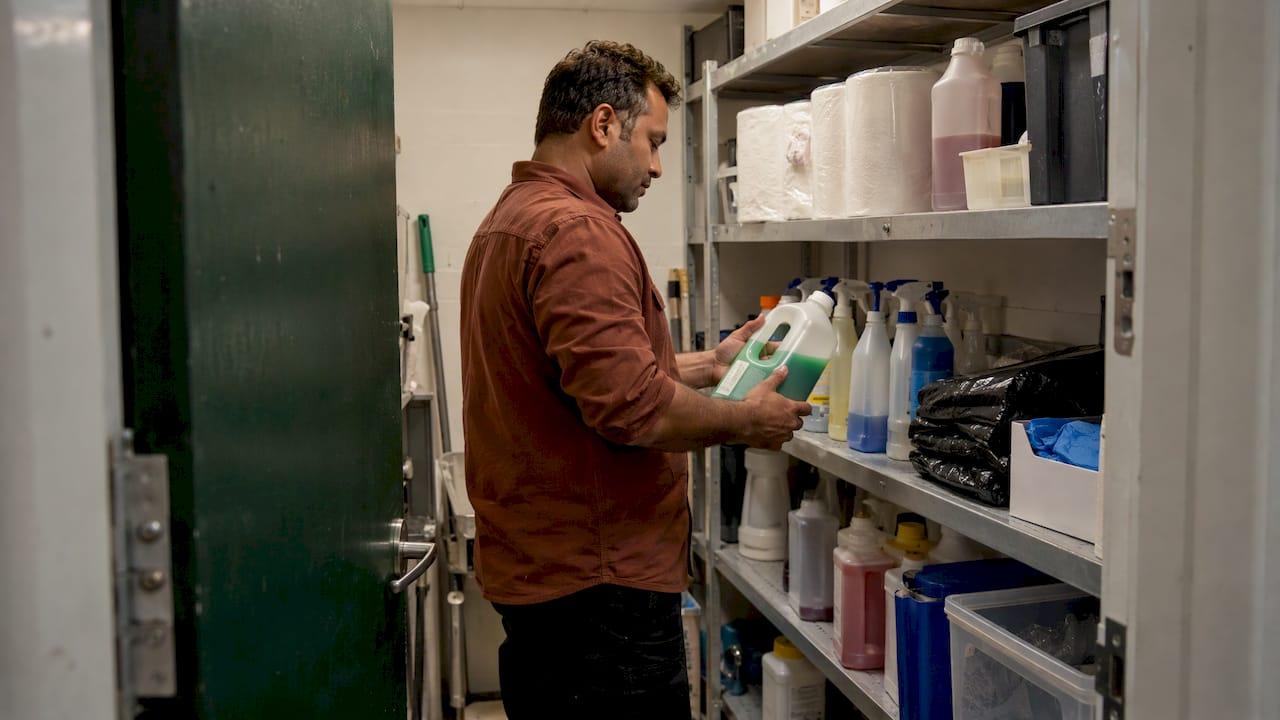
A cleaning supplies inventory works when it is built by zone, counted on a fixed rhythm and tied to par levels, so the sanitiser, bin liners and paper towel never run out on a Friday night. Most venues start with a spreadsheet or a clipboard and a gut feel. That works for a few weeks. Then a busy weekend empties the shelf, someone panic-buys at retail prices, and the cleaning budget quietly eats into your margin. This guide gives you the full routine for cafés, pubs, clubs, fish and chip shops and restaurants, and shows where a platform like Pantryhub takes the counting and reordering off your hands.
TL;DR
- Build the list by zone (kitchen, bar, dishwashing, front of house, washrooms, waste), not by supplier category, so each supervisor can count and order their own area.
- Record item, unit size, location, quantity on hand, minimum and maximum, supplier and expiry date for every line.
- Set par levels from four weeks of real usage: average weekly use multiplied by lead time, plus a buffer.
- Keep a hazardous chemicals register and a current safety data sheet (SDS) for every chemical, and store chemicals away from food in their original containers.
- Put the list in one system with low-stock alerts and supplier ordering, so the count turns into an order without extra steps.
Table of Contents
- Why cleaning stock needs its own inventory
- Step 1: Map your zones first
- Step 2: Separate the three product families
- Step 3: Decide what each line records
- Step 4: Set par levels from real usage
- Step 5: Count on a rhythm the team will keep
- Storing and tracking chemicals safely
- Packaging stock: the same method, different pace
- Using purchase and usage data to stop over-ordering
- Where spreadsheets stop working
- Try it on your own venue
- FAQ
- Sources
Why cleaning stock needs its own inventory
Food gets counted because it is expensive and it spoils. Cleaning supplies get ignored because each item is cheap. But a venue cannot trade without sanitiser, degreaser, dishwashing chemicals, gloves and bin liners, and a missing item stops a shift in a way a missing garnish does not. Weskleen notes that in most operations about 20% of products account for 80% of consumption and cost, which means a handful of lines deserve close attention and the rest can be kept simple.
There is also a compliance side. Chemicals are a workplace health and safety matter in Australia, so a list of what you hold, where it is kept and which safety data sheet goes with it is something you want anyway. One well-built inventory serves both jobs.
A word on who this is for. If you run a venue with several areas and several staff, a shared inventory beats a private mental list. If you hold the keys and do everything yourself, the same routine still applies, just faster.
Step 1: Map your zones first
Start with where cleaning happens, not with what you buy. Packaging Pro's Australian checklist suggests mapping the main operational areas: kitchen, food prep, dishwashing, front of house, washrooms, waste handling and outdoor spaces. Each zone has its own cleaning frequency, risk level and product demand.
For most Australian venues that becomes a simple set of lists:
- Kitchen and food prep: food-safe sanitiser, degreaser, cloths, scourers, gloves.
- Dishwashing: machine detergent, rinse aid, descaler, sink sanitiser.
- Bar: bar towels, glass cleaner, line cleaner, bin liners.
- Front of house: surface spray, glass cleaner, floor cleaner, napkins.
- Washrooms: toilet cleaner, hand soap, toilet paper, paper towel, air freshener.
- Waste and outdoor: bin liners of each size, bin cleaner, brooms, mop heads.
Group the list by area rather than by supplier category. That way the person who closes the bar counts the bar, the chef counts the kitchen, and nobody wanders the storeroom with a list of 80 items.
Pubs and clubs often have more zones than a café: gaming rooms, function rooms, outdoor decks. Give each its own short list. A fish and chip shop may only need three zones, and that is fine. Fewer, clearer zones get counted more reliably.
Step 2: Separate the three product families
One common mistake is treating all cleaning products as one category. Freshway Supplies, an Australian supplier, organizes restaurant stock into three families: food-contact detergent and sanitiser, grease and heavy-soil degreasers, and milder front-of-house presentation products. A food-safe sanitiser will not cut kitchen grease, and a heavy degreaser can leave a film on dining tables.
Put the family on every line of your inventory. It does three things:
- It stops staff substituting the wrong product when the right one runs out.
- It lets you set tighter par levels on the family you cannot trade without (food-contact products).
- It makes safe storage easier, because you can keep degreasers and food-contact products apart from each other and from food.
Then split the list again into chemicals, consumables (cloths, sponges, paper towel, gloves, bin liners, mop heads) and equipment (buckets, spray bottles, mops, colour-coded caddies). Consumables run out weekly. Equipment gets replaced a few times a year. They need different counting rhythms.
Step 3: Decide what each line records
A useful inventory line is short. For each item, capture:
| Field | Why it matters |
|---|---|
| Item and brand | Avoids ordering the wrong product |
| Family and zone | Keeps products matched to the right job |
| Unit size and pack size | 5 L drum or 750 mL bottle changes the count |
| Storage location | The shelf, the bar cupboard, the chemical cabinet |
| Quantity on hand | The count |
| Minimum and maximum | Triggers reordering and caps overbuying |
| Supplier and order code | Makes reordering quick |
| Expiry date | Some products degrade |
| SDS on file | Chemicals only |
Freshway recommends building the stock list from the site's cleaning schedule and setting a minimum and maximum for each line, plus recording the unit of issue, pack size and shelf location. Expiry matters more than most operators expect. Opora, a US supplier, warns that enzymatic cleaners and peracetic acid sanitisers degrade within 6 to 12 months, so buying a year of stock to save on freight can become scheduled waste.
If you already keep a food stock list, use the same layout. Our kitchen inventory checklist shows a format you can extend to cleaning lines.
Step 4: Set par levels from real usage
A par level is the minimum stock that gets you through a trading period, plus a buffer for busy times or late deliveries. Packaging Pro describes it as the stock needed for a defined period plus a buffer for higher demand or delivery delays. The aim is to reorder before you run out, not after.
Here is the method, in four moves:
- Count for four weeks. Note what you use each week of each line. Weekends, functions and school holidays will show up.
- Find average weekly usage. Add the four weeks and divide by four.
- Multiply by lead time. Weskleen's formula is average weekly usage multiplied by delivery lead time, plus a buffer. Their example: 5 litres used a week with a three-business-day delivery means holding a reserve of 7 to 8 litres.
- Set a maximum. Cap it by shelf space, shelf life and cash. A full reserve ties up money.
There is no single right number. Packaging Pro's Paul Horan makes the point that par depends on storage space, delivery frequency, pack size and how predictable your trade is, so a small café with a tight back room should order smaller quantities more often, while a large venue with secure storage can hold deeper reserves.
Treat lead time as measured, not quoted. Count from the day you place the order to the day it is on your shelf, not the carrier's transit estimate.
Tighter control for the lines that matter
Packaging Pro notes that hand soap, sanitiser, bin liners and paper towel need tighter control than slow movers. Weskleen's ABC split is a practical way to do this: Category A essentials (floor cleaner, sanitiser, microfibre cloths, bin liners) get close tracking and a backup supplier, Category B regulars get monitored, and Category C occasional items are ordered on demand. We explain the same idea for kitchens in our guide to ABC inventory analysis.

A worked example for a pub
Say your bar and kitchen go through eight 750 mL bottles of food-safe sanitiser a week, your supplier delivers in two business days, and you want a buffer of about half a week. Lead-time demand is roughly 3 bottles (8 bottles over five trading days, two days of cover is about 3). Add a half-week buffer of 4 bottles and your reorder point is about 7 bottles, with a maximum of perhaps 16 so you never hold more than two weeks. When the count hits 7, the order goes in. These numbers are an illustration of the method, so replace them with your own four weeks of data.
Step 5: Count on a rhythm the team will keep
Pick a rhythm and write it down. Australian suppliers publish similar routines. Freshway suggests a daily visual check, a weekly check of stock and labels (SDS present, stock at par, nothing expired) and a monthly audit of issue records, with the name and date recorded for every check. Big Clean advises a weekly or bi-weekly check and watching usage against the seasons.
For a typical venue this becomes:
- Daily: the closing person looks at the fast movers (sanitiser, bin liners, hand soap, paper towel, dishwash chemicals) and flags anything low.
- Weekly: a full count of chemicals and consumables by zone.
- Monthly: equipment check, expiry check, and a review of usage against par.
Store older stock at the front and newer behind it (first in, first out), and label shelves so a new starter can find and return things. Livingstone International's stocktake guide recommends the same: minimum stock levels, labelled storage and FIFO rotation. If your accounts close on 30 June, a counted cleaning inventory also makes the end-of-financial-year stocktake quicker.
A daily rhythm is easier when counting takes a phone and thirty seconds. Our piece on tracking stock levels daily covers how to keep that habit going.
Storing and tracking chemicals safely
A cleaning inventory in a food business is also a safety record. The rules differ slightly by state and territory, so check the regulator for your location (SafeWork in your state, plus your local council for food safety). The points below come from Australian official sources.
- Keep chemicals away from food, in original containers. The ACT Government's food safety guidance says cleaning chemicals must be stored separately from food and kept in their original containers. Most states give similar direction through their food safety programs.
- Keep a register and current SDSs. SafeWork NSW lists assessing hazardous chemicals, maintaining a hazardous chemical register, providing suitable storage such as spill trays, keeping safety data sheets readily available, keeping flammable or combustible substances to the lowest practical quantity and training workers before first use.
- Label and train. SafeWork NSW's hazard checklist for restaurants and cafés asks whether containers are labelled, whether chemicals are kept away from food preparation areas, whether each hazardous chemical has an SDS, and whether staff wear suitable PPE such as nitrile gloves, aprons and goggles.
- Treat household products as workplace chemicals. Comcare notes that domestic cleaners, safe at home, can present greater risks at work depending on how often and how long they are used, and advises getting an SDS for every chemical and controlling decanting.
- Check deliveries in. The national unit SITHCCC003A on receiving and storing kitchen supplies covers checking deliveries against orders, recording discrepancies and keeping storage areas clean, at the right temperature and free of vermin.
In practice, add two columns to your inventory: "SDS on file" and "storage location". A register then falls out of the list you already count. When you buy a new product, the line does not go live until the SDS is attached. For a safety question about a specific chemical, your state's workplace safety regulator is the right contact.
Packaging stock: the same method, different pace
Takeaway containers, cups, lids, bags, napkins and straws belong in the same system. They are consumables with a clear par level and a short lead time, and for cafés and fish and chip shops they are often the bigger cost. Treat them the same way:
- Count them by zone (counter, takeaway station, storeroom).
- Set par from real sales patterns. Packaging Pro suggests starting with service-critical items such as takeaway cups and lids, napkins, straws and bin liners and reviewing weekdays, weekends, functions and seasonal peaks.
- Watch bulky lines. Cartons of containers take storage space, so your maximum is set by the room, not the supplier's price break.
- Match sizes to menu items. If a menu change drops a container size, set its par to run down to zero rather than reordering out of habit.
Packaging that runs out mid-service is a lost sale, so set these reorder points a little higher than your cleaning lines.
Using purchase and usage data to stop over-ordering
Once counts are recorded, they tell you things a glance at the shelf cannot. Compare what you bought with what you used. A line that is bought every week but never counts down is leaking, whether by waste, theft or poor dosing. A line you always run short of needs a higher par or a faster supplier.
The national unit SITXINV009 on establishing stock control systems covers using business data and forecasting to calculate stock levels, planning for peak seasons and events, and setting cost-effective purchase quantities with supplier advice. That is the same loop in professional terms: count, compare, adjust, repeat.
A monthly review takes ten minutes:
- Which lines hit zero this month?
- Which lines sat untouched?
- Did any delivery come later than the lead time you assumed?
- Does the next month have a big event, a school holiday or a footy final that lifts consumption?
Hospitality owners who want to automate the routine side of running a venue can look at what to automate in a restaurant, and stock counts and reorder alerts are an obvious early candidate.
Where spreadsheets stop working

Paper logs and spreadsheets are a fine start. Their weakness is that they need a person to notice. Someone has to open the file, compare quantity with minimum, and then phone or email an order. With one venue and one careful manager it holds up. With a second site, a casual who closes on Saturday, or a manager on leave, the count slips and the first sign is an empty shelf.
This is where a purpose-built platform pays off: counts are done on a phone, minimums live next to each item, alerts fire when stock falls low, and the order is placed with your supplier from the same screen.
We built Pantryhub in the kitchen, for the kitchen. Operators tell us the same thing: the expensive mistakes are small ones repeated. A bottle of sanitiser here, a carton of lids there, never counted, never reordered on time. That is why we put stock tracking, low-stock alerts, supplier ordering and team access controls in one place, in Australian dollars and with GST-ready reporting. One shared list means the closer, the chef and the manager all see the same numbers, and a multi-location group sees every venue at once.
Our advice is simple. Pick your zones, set par levels from a month of real counts, and let the system do the nagging. Bin the spreadsheets and spend the time on service.
the author
Try it on your own venue
Pantryhub is a hospitality inventory and ordering platform for restaurants, cafés, bars, pubs, clubs and commercial kitchens. It tracks stock in real time, sends low-stock alerts, handles supplier ordering with integration to Australian suppliers, supports multiple locations and gives you waste and cost reporting. Plans are Starter at 39 AUD per month, Regular at 69 AUD per month and Pro at 99 AUD per month, and you can start with a free trial and load your cleaning and packaging lines alongside your food stock.
If you also run a bar, see how bar inventory software handles pour cost and stocktake, or read our overview of hospitality inventory software in Australia.
FAQ
How often should I count cleaning supplies?
Check fast movers such as sanitiser, bin liners, hand soap and paper towel daily by eye, and count every line weekly. Do a monthly review of equipment, expiry dates and usage against par. Busy venues with a high turnover of consumables should keep the weekly count firm.
What is a par level for cleaning supplies?
It is the stock you want on hand to cover a trading period plus a buffer for busy times and late deliveries. Set it from about four weeks of counted usage and your real delivery lead time. Reorder when you reach the reorder point, which sits below par, so stock arrives before the shelf is empty.
Do I need a safety data sheet for everyday cleaners?
Yes, for every chemical you hold, including household products. Comcare advises getting an SDS from the manufacturer for each one, because domestic products can carry greater risk at work. Keep them where staff can reach them and record them in your hazardous chemical register.
Can I manage packaging stock in the same system?
Yes. Cups, lids, containers and bags are consumables, so each gets a unit size, a location, a minimum and maximum and a supplier. Base par on weekday, weekend and seasonal sales, and watch storage space, since packaging is bulky.
Sources
- Restaurant Cleaning Supply Checklist Example, Packaging Pro
- Bar Supply Organisation for Faster Service, Packaging Pro
- Restaurant Cleaning Supplies Checklist by Zone, Freshway Supplies
- Cleaning Storeroom Organisation, Freshway Supplies
- Cleaning Inventory Management, Weskleen Supplies
- Janitorial Supply Par Levels Guide, Opora
- Create the Perfect Cleaning Kit, Big Clean
- EOFY Stocktake Guide, Livingstone International
- Chemical fire fatality, SafeWork NSW
- Hazard identification checklist, SafeWork NSW
- Protecting food from contamination, ACT Government
- Kitchen cleaning products, Comcare
- SITHCCC003A Receive and store kitchen supplies, training.gov.au
- SITXINV009 Establish stock control systems, training.gov.au