

PAR (Periodic Automatic Replenishment) sets a fixed target quantity you refill back up to on a schedule, usually by eye or a quick count. Min-Max sets two thresholds: a reorder point (Min) that triggers a purchase, and an order-up-to ceiling (Max) that defines how much to buy. Use PAR when you want simple, station-level refills on a routine cadence; use Min-Max when you need continuous, quantity-based reorder control across variable usage. Both fail without safety stock and regular recalibration.
TL;DR:
- Min-Max offers reactive ordering based on on-hand triggers, making it ideal for variable demand and bulk stock management in hospitality settings.
- PAR is best suited for routine, predictable reordering at fixed intervals, especially for front-of-house items with fast turnover.
- Both methods depend on accurate usage data, lead times, and safety stock; poor counts can render either system ineffective.
- Regular recalibration of levels is critical, with perishables needing weekly review and slow-moving items monthly or quarterly, to prevent stockouts or overstocking.
- Most operations benefit from combining both methods across different SKUs and storage areas, aligning control logic with item shelf life and demand variability.
Table of Contents
- Par vs Min Max: How the Two Methods Actually Compare
- How Each Method Works: Definitions, Inputs, and Formulas
- Worked Example: Same SKU, Two Methods, Different Numbers
- When to Use Par vs Min Max in a Hospitality Setting
- Setting Up Par and Min-Max in Your Inventory System
- Monitoring and Recalibrating Your Levels Over Time
- How Pantryhub Handles Par and Min-Max in Practice
- The Real Trade-Off Nobody Talks About
- Sources
Par vs Min Max: How the Two Methods Actually Compare
Both methods answer the same question, "how much stock should be here right now?" They just get there differently. PAR works on a calendar. Min-Max works on a trigger.
| Factor | PAR | Min-Max |
|---|---|---|
| Definition | Fixed target quantity refilled to on a set schedule | Two thresholds: Min (reorder point) and Max (order-up-to level) |
| Trigger | Time-based (daily, per shift, weekly count) | Quantity-based (on-hand drops to or below Min) |
| Order quantity | Par level minus current on-hand | Max minus current on-hand |
| Best for | Station-level, fast-turning items with predictable use | Central stores, bulk goods, variable-demand SKUs |
| Calibration cadence | Weekly to monthly, more often for perishables | Monthly to quarterly, tied to usage and lead-time shifts |
| Pros | Fast to count, easy for staff to learn, low admin overhead | Reacts to real usage, reduces overstock, works well with automated purchasing |
| Cons | Can overbuy on slow days or underbuy on busy ones | Requires accurate on-hand tracking and lead-time data |
Most vendor systems, including Oracle's inventory documentation, treat PAR and Min-Max as configurable but mutually exclusive settings at the subinventory level. That distinction matters more than most operators realize, and the next section breaks down why.
How Each Method Works: Definitions, Inputs, and Formulas
PAR and Min-Max both rely on the same three raw inputs: average daily usage, supplier lead time, and safety stock. What differs is how those inputs combine.
Par level is the quantity you want on hand after a refill, calculated as:
Par level is generally calculated as the product of average daily usage and lead time in days, plus safety stock
That's the standard formula used across supply chain training material, and it applies whether you're counting bottles of vodka or cases of chicken thighs. The order quantity at refill time is simply par minus whatever is currently on the shelf.
Min-Max splits the same logic into two separate numbers:
- Min (reorder point): the on-hand level that triggers a new order, often set equal to par
- Max (order-up-to level): the ceiling you order back up to once triggered
- Order quantity: Max minus current on-hand at the moment the trigger fires
That order-up-to arithmetic is documented clearly in Firehouse Software's inventory onboarding guide, and it's the same logic most restaurant platforms use under the hood.
Safety stock is the buffer that absorbs the unpredictable parts: demand spikes on a Friday night, a supplier running a day late, a delivery truck stuck in traffic. Skip it and you're relying purely on averages, which leads to frequent stock shortfalls due to demand variability, based on standard safety stock guidance. In practice, Min often equals par exactly, because both represent "the point where you need more stock before you run out."
Worked Example: Same SKU, Two Methods, Different Numbers
Take a busy café's house-brand milk. Average daily usage is 20 liters. Lead time from the supplier is 2 days. Safety stock, based on demand variability during weekend rushes, is set at 10 liters.
- Calculate par level. (20 liters × 2 days) + 10 liters = 50 liters. Under a periodic PAR system, staff count milk every morning and refill up to 50 liters regardless of exactly how much is left.
- Calculate order quantity under PAR. If the count shows 18 liters on hand, the order is 50 minus 18, or 32 liters.
- Set Min and Max for the same SKU. Min is set equal to par, and Max is set higher to provide buffer stock for the order cycle.
- Trigger the Min-Max order. As soon as on-hand hits 50 liters, at any point during the day, the system (or a staff member checking stock) fires an order for 70 minus current on-hand.
- Track the timeline. Over the lead time, usage is expected to reduce the stock significantly between orders. If the order fires right at the 50-liter mark, the café should land close to 10 liters on hand when the new delivery arrives, matching the safety stock buffer almost exactly.
The difference shows up in the timing. PAR checks once a day and refills to a flat number. Min-Max checks continuously (or as often as your system allows) and reacts the moment stock crosses a line. For fast-moving perishables with unpredictable swings, that continuous trigger closes gaps a once-a-day count simply can't catch. Structured, scheduled replenishment reviews like these are also linked to fewer stockouts and less wastage in operational research on multi-location inventory management.
When to Use Par vs Min Max in a Hospitality Setting
The right method depends on four factors: how much demand swings day to day, how often your supplier delivers, how much storage you have, and how fast the product expires.
- High demand variability, frequent deliveries, low storage (bar spirits, fresh produce): Min-Max usually wins, since it reacts to real consumption instead of a flat schedule.
- Predictable demand, simple counting, front-of-house workflow (napkins, condiment packets, coffee cups at a service station): PAR keeps things simple and fast for staff doing a visual check between shifts.
- Bulk central-store items with long shelf life (dry goods, canned stock, cleaning supplies): Min-Max fits well here too, since order-up-to logic prevents both overstock and last-minute scrambles.
- Seasonal or promotional SKUs: neither method works well on stale averages. Recalculate using a comparable prior season instead of a flat trailing average, a point echoed in supply chain guidance on seasonal par recalculation.
Most hospitality operations end up mixing both. Front-of-house stations run on PAR because counting is quick and staff don't need purchasing authority. Central stores run Min-Max because bulk items justify the extra tracking precision. This split lets a bar's fast-moving stock stay lean while back-of-house dry storage stays protected against a missed delivery.
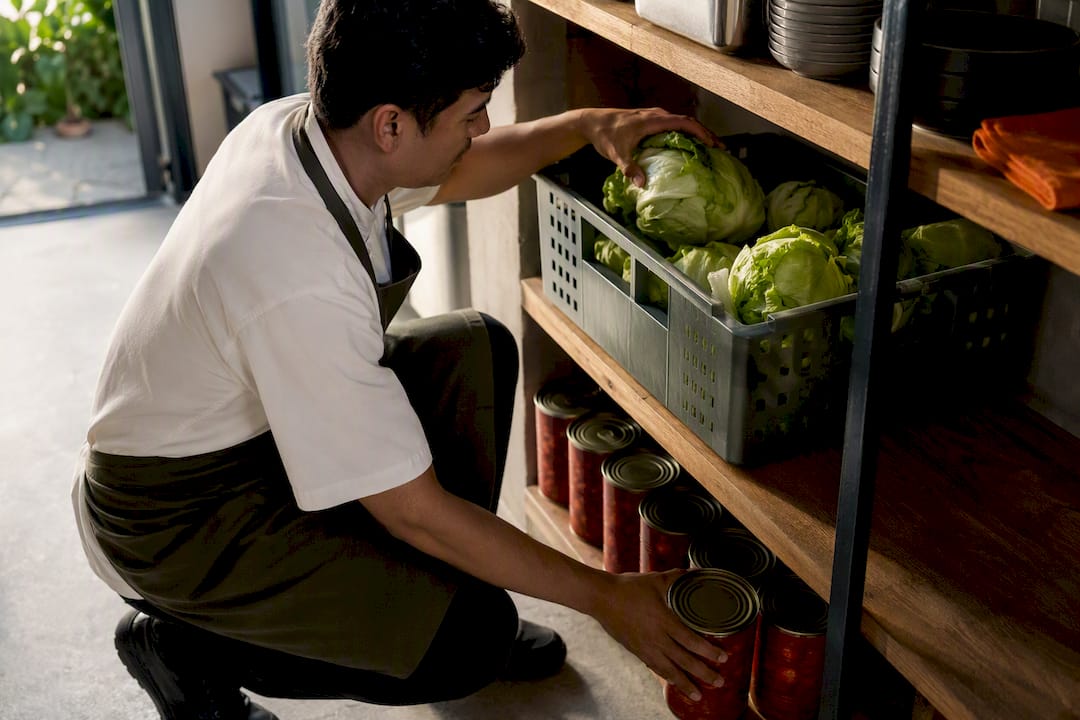
Pro Tip: Don't force one method across every SKU in a location. A walk-in cooler with 40 items rarely needs the same control logic for lettuce and canned tomatoes. Match the method to the item's shelf life and demand pattern, not to whatever the last system defaulted to.
Setting Up Par and Min-Max in Your Inventory System
Most inventory platforms handle PAR and Min-Max as separate configuration modes, and many won't let you run both at once for the same location. Oracle's own configuration documentation confirms that enabling PAR at the subinventory level disables min-max planning for that same subinventory, so the choice has to be made deliberately, not by accident.
A workable setup checklist:
- Choose the mode per location, not per business. A single café might run PAR at the counter and Min-Max in the back office.
- Use bulk upload templates to set initial par or min/max values across dozens of SKUs at once instead of entering them one by one.
- Let the system auto-calculate suggested values, then review before publishing. Vendor guidance consistently recommends a review-and-publish step so a bad calculation doesn't silently blow out your storage capacity or trigger a huge, unnecessary order.
- Assign clear ownership. Someone specific needs to own the count cadence for PAR items and the on-hand accuracy for Min-Max items.
- Connect supplier ordering. Automated purchase orders only work if the system's on-hand numbers match reality, which means counts need to happen on schedule, not "when someone remembers."
- Train staff on the difference. A team that doesn't understand why milk refills to a flat number while dry goods trigger mid-week orders will eventually override both systems with guesswork.
Monitoring and Recalibrating Your Levels Over Time
Setting par or min-max levels once and walking away is the single fastest way to end up back on spreadsheets within a quarter. Levels drift as menus change, seasons shift, and suppliers adjust lead times.
Track these KPIs on a regular basis:
- Fill rate — the percentage of orders met from current stock without a stockout. Falling fill rates usually mean your par or min is set too low for current usage.
- Days on hand — how long current inventory would last at average usage. Rising days on hand signals overstocking and tied-up cash.
- Turnover rate — how often stock cycles through in a given period, useful for spotting slow-moving SKUs still sitting on a high par.
- Carrying cost — the cost of holding inventory, including spoilage risk on perishables.
- Stockout frequency — how often a SKU actually hits zero, which is the clearest sign your safety stock buffer needs adjusting.
Recalibrate fast-moving perishables weekly, since demand swings hit them hardest. Slower-moving dry goods and cleaning supplies can go monthly or quarterly. The most common mistake is recalculating a seasonal item using a flat trailing 12-month average, which flattens out the summer spike or holiday surge you actually need to plan for. The second most common mistake is ignoring lead-time changes. A supplier that used to deliver in 2 days but now takes 4 needs a recalculated par immediately, not at the next scheduled review. Regular audits against common inventory mistakes restaurants make catch these blind spots before they turn into a wasted delivery or an empty walk-in on a Saturday night.
How Pantryhub Handles Par and Min-Max in Practice
Pantryhub tracks stock at the ingredient level, so par and min-max figures reflect what's actually in the walk-in, not a rough guess. Low-stock alerts flag items nearing their reorder point in real time, whether that item is running on a flat par or a min-max trigger. Bulk upload templates let you set initial levels across every SKU in one pass, and supplier integration turns a triggered reorder into a purchase order without someone manually calling it in.
For multi-location groups, that visibility extends across multiple venues, which matters when different sites use different inventory methods in various storage areas. Reporting tools built for ingredient-level stock tracking feed straight into the recalibration KPIs covered above.
The Real Trade-Off Nobody Talks About
Most guides frame this as a technical choice between two formulas. It isn't. It's a staffing choice disguised as a math problem.
PAR works because it asks almost nothing of your team beyond a quick visual count. That's its entire value. The moment you overcomplicate PAR with safety stock nuance and seasonal adjustments, you've lost the reason to use it over Min-Max in the first place. If your team needs that level of precision, just run Min-Max properly.
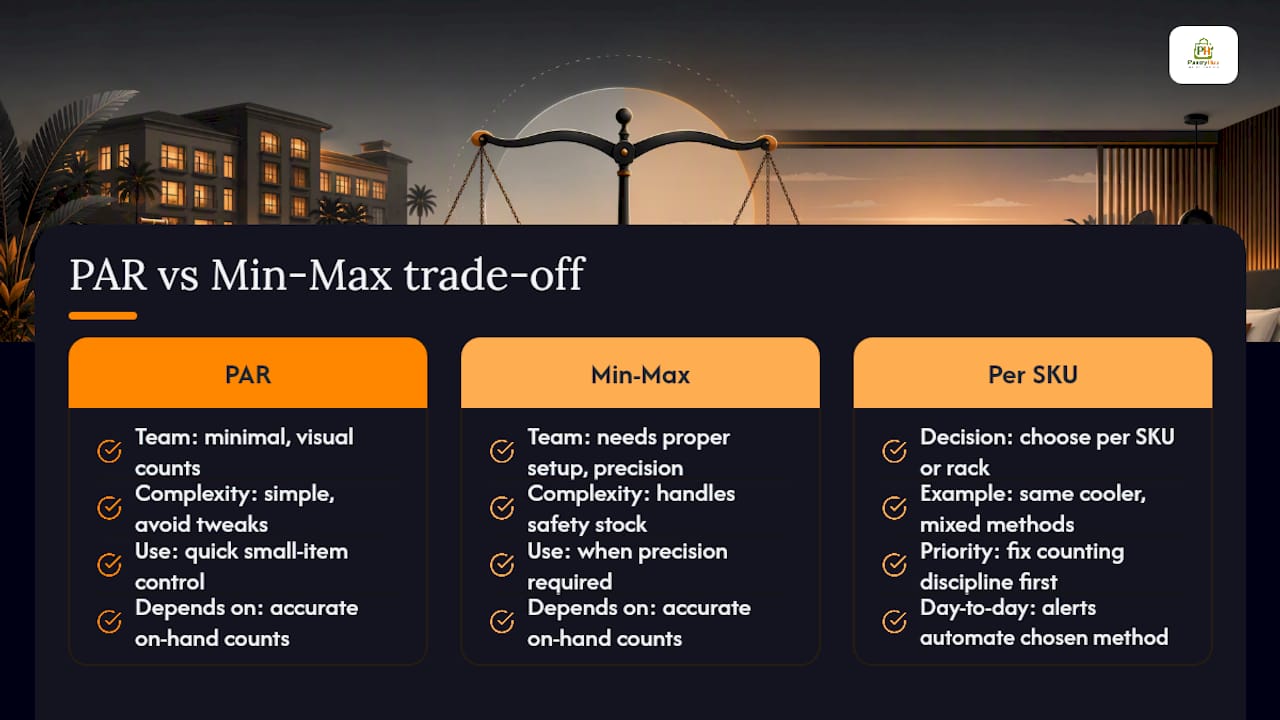
Where conventional advice falls short is treating this as an either/or decision at the business level. The right call happens at the SKU level, sometimes the location level. A single walk-in cooler can reasonably run both methods depending on the shelf life sitting on each rack.
Prioritize accurate on-hand counts before worrying about which formula to apply. Neither method survives bad counting. Get the counting discipline right first, choose the method second, and revisit both every time a supplier's lead time or a menu changes.
— Admin
Ready to stop guessing which method fits which shelf? Pantryhub's hospitality inventory software tracks ingredient-level stock, sends low-stock alerts, and connects directly to your suppliers, so whichever method you choose actually runs itself day to day.
Sources
- Redwood: Review Min-Max Quantities and PAR Levels Before Updating Current Values — Oracle
- Par-Level & Reorder Calculations — OpenExamPrep
- Set minimum and maximum par levels — Firehouse Software