

A minimum order quantity, or MOQ, is the smallest number of units or the lowest total order value a supplier will accept on a single order. If the MOQ a supplier quotes doesn't match your demand or your cash capacity, your move is simple: compare it against your carrying costs and sell-through speed, then negotiate the terms or find an operational workaround before you sign.
TL;DR:
- Buyers should verify if the supplier’s MOQ in units or total order value aligns with their demand and cash flow, especially on value-based MOQs requiring around 400 units for $10,000 orders.
- Understanding fixed costs, packaging, upstream vendor minimums, and setup expenses can help negotiate MOQs more effectively, particularly by asking suppliers for detailed cost breakdowns.
- Contract language like take-or-pay, penalties, and inspection windows is legally binding and must be reviewed carefully before signing agreements to avoid unexpected obligations.
- Small businesses and startups are more impacted by MOQs due to slower sell-through and limited cash flow, often benefiting from sourcing through distributors or buying cooperatives.
- Calculating inventory longevity, carrying costs, and EOQ compared to supplier MOQs enables more informed decisions, preventing overstocking and excessive working capital lock-up.
Table of Contents
- What Is a Minimum Order Quantity, Exactly?
- Why Suppliers Set MOQs in the First Place
- The Different Shapes MOQs Take, and the Contract Clauses That Bite
- How MOQs Hit Your Cash Flow, Storage, and Shelf Life
- How to Calculate Whether an MOQ Actually Works for You
- Negotiating and Managing MOQs Without Blowing Up Your Cash Flow
- A Checklist to Run Before You Accept Any MOQ
- Impact of MOQs on Small Businesses and Startups
- Industry-Specific MOQ Variations and Examples
- Legal or Contractual Considerations Related to MOQs
- What Kitchens Consistently Get Wrong About MOQs
- How PantryHub Takes the Guesswork Out of Supplier Minimums
- Sources
What Is a Minimum Order Quantity, Exactly?
An MOQ shows up in two forms, and mixing them up costs money. A unit-based MOQ sets a hard floor on quantity, like 500 units of a single SKU. A value-based MOQ sets a floor on total spend, like a $10,000 minimum, regardless of how many different products fill that basket. Both types exist because MOQs are set to cover a supplier's fixed production and fulfillment costs, not because suppliers enjoy turning away smaller buyers.
A third wrinkle: order multiples, sometimes called increments. A supplier might set an MOQ of 200 units but only sell in packs of 50, meaning your real options are 200, 250, 300, and so on. First orders often carry a higher minimum than reorders too, since the supplier is absorbing new-account setup costs the first time around.
Here's the conversion buyers get wrong most often. Say a supplier quotes a value-based MOQ on a product priced at $12.50 per unit wholesale that translates to 400 units required to hit the floor. If your average order is normally smaller, you're being asked to carry more stock than usual.
- That gap is exactly what you need to check against your monthly sell-through before you commit.
Quick fact: a value MOQ with a total order value around $10,000 on a unit cost near $25 translates to roughly 400 units on the shelf, whether you wanted that many or not.
Why Suppliers Set MOQs in the First Place
MOQs aren't arbitrary gatekeeping. They're a direct reflection of the supplier's own cost structure, and understanding that structure is what makes negotiation possible instead of adversarial.
Four cost drivers show up again and again:
- Fixed setup and run costs. Machine changeovers, tooling, and labor to start a production run cost the same whether you order 100 units or 10,000, so the supplier needs volume to spread that cost thin.
- Packaging and shipping efficiency. Case packs, pallet configurations, and freight rates are built around round numbers. A half-empty pallet still costs a full pallet's freight.
- Upstream vendor minimums. Your supplier's own raw-material or component vendors often impose MOQs on them, and that constraint gets passed straight down the chain to you.
- First-order account setup. New buyer accounts mean credit checks, sample runs, and paperwork. Suppliers frequently price that overhead into a higher initial MOQ, then lower it once you're a known, repeat customer.
The practical upshot is that a supplier's break-even MOQ approximates fixed run cost divided by profit per unit. That's not a formula they'll hand you, but it's the logic behind the number, and it tells you exactly where the negotiation leverage sits.
Pro Tip: Ask a supplier point blank what portion of the MOQ is driven by packaging versus production setup. Suppliers who answer specifically are usually the ones willing to flex; vague answers often mean the number is padded.
The Different Shapes MOQs Take, and the Contract Clauses That Bite
Not all MOQs are structured the same way, and the fine print around them matters as much as the headline number.
Simple MOQs are a flat floor: order at least X units, no exceptions. Tiered (complex) MOQs scale pricing with volume, so 500 units might cost $8 each while 2,000 units drops to $6.50. Value-floor MOQs set a dollar minimum across a mixed basket of SKUs, giving you more flexibility in what you order as long as the total clears the bar. Order increments layer on top of any of these, forcing purchases in fixed multiples rather than exact quantities.
The contract language around these structures deserves your full attention:
- Take-or-pay clauses obligate you to pay for a committed volume even if you don't take delivery, a real risk if your demand forecast is soft.
- Liquidated damages provisions specify a penalty if you cancel or under-order, and the amount is negotiable if you catch it before signing.
- Inspection and acceptance windows define how long you have to reject defective goods after delivery. A short window paired with a large MOQ order is a bad combination if quality control takes time.
Contractual terms around MOQs are legally binding, which means a verbal understanding about flexibility means nothing once you've signed a purchase agreement with a take-or-pay clause buried in it. Read every MOQ term before it hits your signature, not after.
How MOQs Hit Your Cash Flow, Storage, and Shelf Life
An MOQ that looks like a bargain on a per-unit basis can quietly wreck your working capital. The math that exposes this is simple: months of stock = MOQ ÷ average monthly sales.
If a supplier's MOQ is 1,200 units and you sell 200 units a month, you're carrying six months of inventory. That's not automatically bad, but it's a number you need to know before you order, not after the pallets arrive.
Carrying that stock isn't free. Carrying costs typically run 20 to 30% of inventory value per year, covering storage space, insurance, spoilage risk, and the opportunity cost of cash tied up in boxes instead of working for you elsewhere.
Quick fact: at a 25% carrying cost rate, a $20,000 order sitting in your storeroom for a full year costs you roughly $5,000 in holding expense alone, before a single unit spoils or goes stale.
Perishable goods and trend items amplify this risk sharply. A 15-month supply of a shelf-stable component is an inconvenience; a 15-month supply of a seasonal or perishable SKU is a write-off waiting to happen. The warning signs to watch for: months of stock above your normal reorder cycle, a SKU with volatile or seasonal demand, and storage capacity that's already tight before the new order arrives.

How to Calculate Whether an MOQ Actually Works for You
Run these four steps before you accept any MOQ, and you'll know within minutes whether it's a fit or a liability.
Step 1: Determine monthly demand and safety stock. Pull your last 3 to 6 months of sales data for the SKU and add a safety buffer, usually 1 to 2 weeks of extra coverage for demand spikes or supplier delays.
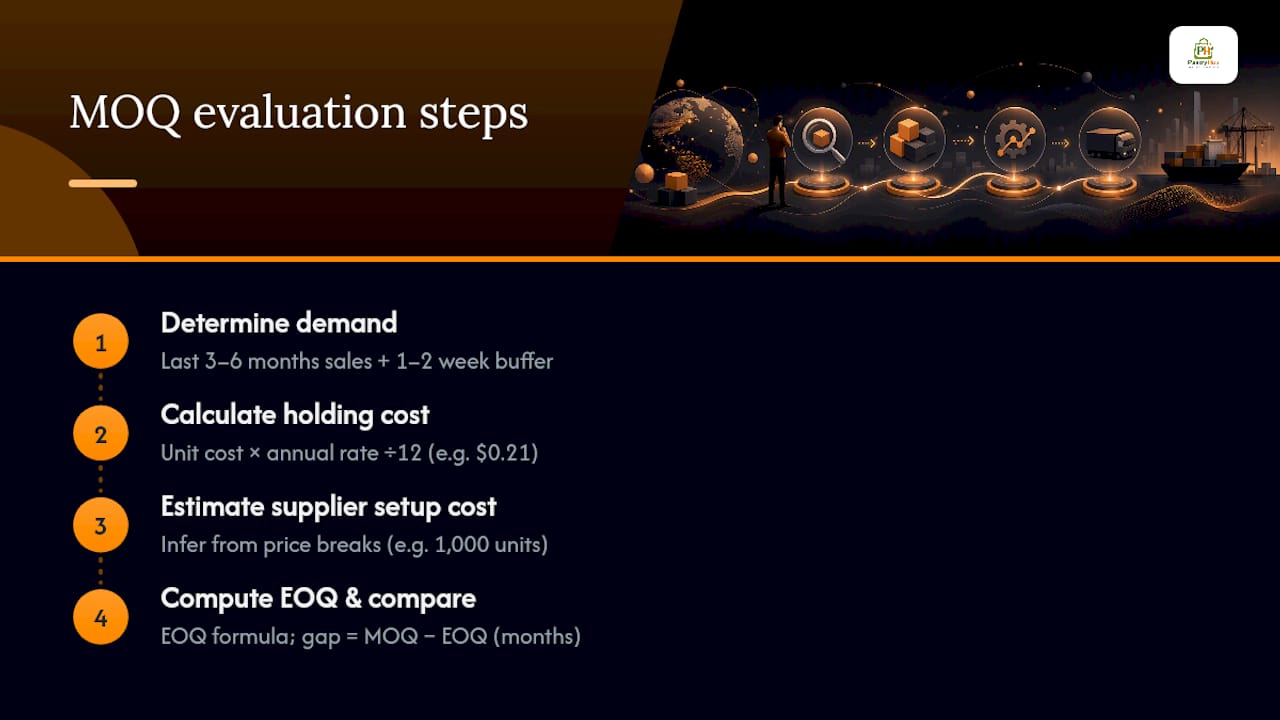
Step 2: Calculate holding cost per unit. Take your unit cost and multiply by your annual carrying-cost rate (commonly 20–30%), then divide by 12 for a monthly figure. A $10 unit at 25% annual carrying cost runs about $0.21 per unit per month in storage, insurance, and capital cost.
Step 3: Estimate the supplier's fixed setup cost and break-even MOQ. You often can't get this number directly, but you can reverse-engineer it. If a supplier's tiered pricing shows a big price break at 1,000 units, that's a strong signal their fixed costs amortize favorably above that line.
Step 4: Compute your Economic Order Quantity (EOQ) and compare it to the supplier's MOQ. The classic EOQ formula is:
EOQ = √((2 × Demand × Order Cost) ÷ Holding Cost per Unit)
If your EOQ comes out to 300 units but the supplier's MOQ is 1,000, you have a 700-unit gap to either negotiate away or plan storage and cash flow around.
Worked example:
Here the EOQ sits at roughly 520 units, but the MOQ demands 1,000. That's a 480-unit surplus, translating into roughly 3.2 extra months of stock beyond what your ordering math actually calls for. That's the number to bring into a negotiation, not a vague complaint that "the MOQ feels too high."
Negotiating and Managing MOQs Without Blowing Up Your Cash Flow
Once you know the gap between your EOQ and the supplier's MOQ, you have specific, defensible ground to negotiate from. A handful of tactics consistently move suppliers:
- Offer a higher unit price on a smaller run. Paying more per unit or putting down a larger deposit compensates the supplier's fixed costs directly, and it's often the fastest way to unlock flexibility on a first order.
- Propose a blanket purchase order. Commit to a total annual volume that meets or exceeds their MOQ, but request staggered deliveries in smaller batches. This satisfies the supplier's need for predictable revenue while solving your storage and cash problem.
- Consolidate SKUs into one run. If a value-based MOQ is the barrier, combine multiple product lines into a single purchase order to clear the dollar floor without overbuying any single item.
- Point to a repeat-order history or forecast. Suppliers are usually far more willing to flex a quoted MOQ when a buyer removes their risk with a credible, predictable order plan rather than a one-off request.
When negotiation stalls, fallback options exist. Distributors and wholesalers typically carry lower minimums than the original manufacturer, though you'll pay a higher per-unit price for that flexibility. Small-batch specialists serve the same purpose in categories like specialty food and beverage.
The decision of when to accept a higher price versus walking away comes down to one comparison: does the price premium cost less than the carrying cost of over-ordering?
Pro Tip: Before any negotiation call, calculate your walk-away number, the maximum unit price you'd accept on a smaller order. Knowing that figure in advance keeps a supplier's counteroffer from feeling like a win when it's actually a loss.
A Checklist to Run Before You Accept Any MOQ
Work through this list before you commit to a purchase order, not after the goods are already in transit.
- Calculate months of stock. MOQ ÷ average monthly sales tells you how long the inventory will sit.
- Total the cash tied up. Multiply MOQ units by unit cost, including landed freight and duties.
- Check physical storage capacity. Confirm you have space before the order arrives, not room you're hoping to free up later.
- Build a sell-through plan. Know specifically how you'll move the volume, whether through existing demand, a promotion, or a new sales channel.
- Review the acceptance and inspection terms. Confirm the contract's inspection window and any take-or-pay exposure before signing.
Worked example: a $10,000 value-based MOQ on a product averaging $2,000 in monthly sales equals five months of stock. At a 25% annual carrying cost, that $10,000 order costs roughly $208 a month in holding expense while it sits, on top of the capital you can't deploy elsewhere.
Quick fact: holding several months of stock beyond a typical reorder cycle can create meaningful risk and costs.
Impact of MOQs on Small Businesses and Startups
MOQs hit small businesses harder than established players, and the reason is structural, not circumstantial. A large retailer can absorb a 1,000-unit MOQ because their sell-through velocity clears it in weeks. A startup selling the same product might need six months to move that volume, tying up cash that a young business usually can't spare.
The compounding problem is credit access. Suppliers extend better terms, and sometimes lower MOQs, to buyers with an established payment history. New businesses without that track record often face both a higher MOQ and stricter payment terms simultaneously, a double bind that early-stage operators need to plan around rather than be surprised by.
The workaround many startups miss is sourcing through distributors rather than manufacturers directly for the first several orders. The unit economics are worse, but the cash and storage relief usually outweighs the margin hit until sales volume justifies going direct. Consolidating orders across a small group of similar businesses, sometimes called a buying cooperative, is another route worth exploring in categories like specialty ingredients or packaging.
The core discipline for a small operator is treating every MOQ decision as a cash-flow decision first and a unit-cost decision second. A cheaper unit price that locks up four months of operating cash is rarely the better deal.
Industry-Specific MOQ Variations and Examples
MOQ norms vary sharply by category, and applying one industry's expectations to another leads to bad assumptions.
In apparel and textiles, MOQs commonly run in the hundreds or low thousands of units per color and size combination, driven by fabric-cutting efficiency. In electronics components, MOQs are often set by the reel or tape size components ship in, sometimes forcing orders of several thousand units even for a simple part. In specialty food and beverage, MOQs tend to track batch sizes for the specific piece of production equipment, whether that's a bottling line or a commercial oven, so a 500-unit MOQ might reflect exactly one production run.
For restaurants, cafés, and commercial kitchens, MOQs show up constantly in supplier relationships, from a case-pack minimum on a specialty sauce to a pallet minimum on packaging supplies. Sourcing from local suppliers instead of large-scale distributors sometimes lowers MOQs on perishables since smaller producers often work in smaller batch sizes to begin with, though pricing and consistency can vary more than with an established wholesale channel.
Construction materials and industrial supplies often carry pallet or truckload minimums tied directly to freight economics rather than production costs. The lesson across every category is the same: ask what specifically drives the number before assuming it's negotiable or fixed.
Legal or Contractual Considerations Related to MOQs
An MOQ quoted in an email or a sales conversation isn't the same thing as an MOQ written into a signed purchase agreement, and the difference matters more than most buyers realize.
MOQ terms embedded in a formal contract are legally binding, which means a supplier can enforce a take-or-pay clause even if you verbally discussed flexibility during negotiations. Get every agreed change to an MOQ, whether it's a lower first-order threshold or a staggered delivery schedule, confirmed in writing before you sign anything.
Installment contracts, where a single large order is legally structured as multiple smaller deliveries, need particular attention to how each installment is invoiced and what happens if you cancel mid-schedule. Liquidated damages clauses specifying a penalty for under-ordering are negotiable, and it's worth pushing back on any number that isn't tied to the supplier's actual cost exposure.
Payment terms are their own legal layer worth understanding. Qualifying for extended terms like net 30 typically requires a credit application or trade references, and early-payment discounts such as 2/10 net 30 convert into real savings on a large MOQ order.
Before signing, confirm exactly what happens if goods fail inspection, whether the MOQ resets on rejected items, and how disputes over quantity or quality get resolved. A short conversation with a purchasing attorney on your standard supplier agreement template is worth more than the hourly fee the first time it prevents a take-or-pay dispute.
What Kitchens Consistently Get Wrong About MOQs
The same three mistakes show up across restaurant and café inventory again and again. Over-ordering to "get past" an MOQ without checking real sell-through velocity. Tracking stock at the category level instead of the SKU level, which hides exactly which items are creating the carrying-cost drag. And ignoring carrying costs entirely, treating a bulk discount as pure savings without weighing the storage, spoilage, and cash-flow cost sitting behind it.
Software closes that gap by giving you the SKU-level visibility that manual tracking almost never catches in time. Forecasting tools flag when a supplier's MOQ would push you past a safe months-of-stock threshold, low-stock alerts catch the reorder point before you're stuck accepting a rushed emergency order, and supplier-ordering integrations let you stagger deliveries against a single negotiated commitment instead of taking a full MOQ all at once.
— Admin
How PantryHub Takes the Guesswork Out of Supplier Minimums
PantryHub gives kitchens the SKU-level sell-through data that turns a vague MOQ negotiation into a confident one, and that's the real advantage over sourcing decisions made on gut feel and a spreadsheet.
Instead of guessing whether a supplier's 500-unit minimum will sit in your storeroom for two months or six, PantryHub's hospitality inventory software tracks real consumption rates per ingredient and flags low stock before you're forced into a rushed, oversized reorder. Multi-location operators can stagger deliveries against a single supplier commitment, spreading a large MOQ across sites instead of stockpiling it in one kitchen. The kitchen inventory app puts that data in your pocket during supplier calls, so you're negotiating from actual sell-through numbers instead of estimates.
Plans start at pricing from A$39 a month, with a free trial available if you want to see your own SKU data before committing to a plan.
Sources
- Minimum Order Quantity guide — iSend
- Minimum Order Quantity (MOQ): How to Negotiate and Plan | OmniOrders
- What Is Minimum Order Quantity? Contracts and Risks - LegalClarity
- Manage payments to suppliers — Business Victoria