

The most effective franchise inventory management strategy pairs three things: centralized real-time visibility, enforceable standard operating procedures, and software built for multi-location operations. Franchise systems that get this right see fewer stockouts, less cash tied up in dead stock, and consistent execution across every unit. Pantryhub is built as the operational backbone for exactly this kind of control across hospitality locations.
TL;DR:
- Centralized, real-time inventory visibility helps franchise systems prevent stockouts and avoid tying up cash in dead stock across multiple locations.
- Enforceable SOPs and regular training are essential to minimize shrinkage caused by small gaps in receiving, stock-taking, and markdown procedures.
- Selecting franchise-specific inventory software with multi-site tracking, transfer workflows, and integration capabilities supports scalable and automated operations.
- A phased rollout starting with pilot stores, comprehensive master data, and continuous measurement ensures successful implementation of centralized control.
- Building the catalog, standardizing procedures, and providing consistent training before software deployment prevents inheriting operational gaps.
Table of Contents
- What Are the Core Components of Franchise Inventory Management?
- How Do You Balance Central Control With Local Flexibility?
- What SOPs Reduce Shrinkage and Free Up Working Capital?
- How Do You Choose Franchise-Ready Inventory Software?
- How Do You Roll Out Centralized Inventory Control?
- How Pantryhub Supports Franchise Inventory Goals
- What Franchise Operators Get Wrong About Inventory Control
- Getting Started With Franchise-Ready Inventory Software
- Sources
What Are the Core Components of Franchise Inventory Management?
Every franchise system that keeps inventory under control shares four building blocks. Miss one and the others start compensating, badly.
The first is consolidated, real-time visibility. When a franchisor cannot see stock levels across every location in one place, data fragments across spreadsheets, POS exports, and phone calls to store managers. A unified inventory view lets head office spot a store running low on a core item while a neighboring location sits on surplus and triggers a transfer before either becomes a problem.
The second is predictive forecasting. Static par levels waste money because demand shifts with seasons, promotions, and local events. Automated replenishment tools that read historical sales data catch these swings faster than a manager checking shelves once a week.
Third, a central catalog acts as the single source of truth for every SKU, unit of measure, and recipe. Without it, one store's "case of tomatoes" means something different from another's, and reporting falls apart.
Fourth is the procurement model. Options include:
- Centralized purchasing, where the franchisor negotiates directly with suppliers.
- A centralized distribution center (CDC) that consolidates orders and ships uniform product to each unit.
- Approved vendor lists with negotiated rates franchisees order from independently.
Centralizing vendor negotiations tends to reduce costs and improve fulfillment predictability compared to letting each location source independently, and CDCs add consistency and cost savings by consolidating shipments across the network.
How Do You Balance Central Control With Local Flexibility?
Franchisors who try to control every SKU at every location eventually pick a fight with the franchisees who know their neighborhood best. The better model draws a clear line: head office owns the core assortment, and each location gets a defined lane to adapt.
Core items, usually the products tied to brand standards and recipe consistency, stay locked at the network level. Local assortments, like a seasonal special or a regional supplier substitution, get approved within limits the franchisor sets in advance. Governance tools that support this split typically rely on:
- Quotas that cap how much of a discretionary item a store can order.
- Silent flags that alert head office to unusual order patterns without blocking the transaction.
- Role-based access that limits who can approve exceptions.
- Override workflows for legitimate one-off needs, like a catering event.
An order management layer built for franchises can automate fair sourcing and expose channel-specific visibility rules so each location sees only what applies to it.
One decision franchisors often defer too long: whether inventory is franchisor-owned (consignment) or franchisee-owned (firm-sale). This affects royalty calculations and reconciliation complexity from day one.

Pro Tip: Choose silent flagging over hard blocks for governance checks. Franchisees who feel surveilled push back; franchisees who feel supported adopt the system faster.
What SOPs Reduce Shrinkage and Free Up Working Capital?
Shrinkage rarely comes from one dramatic event. It comes from a hundred small gaps: a receiving clerk who skips the count, a stock-take done from memory, a markdown entered late. Consistent SOPs combined with regular training close those gaps across every unit, not just the well-run ones.
A practical SOP checklist covers:
- Ordering: require par-level triggers, not gut-feel reordering, and log who approved each purchase order.
- Receiving: match delivery quantities against the invoice before signing, every time, with no exceptions for trusted drivers.
- Stock-taking: run counts on a fixed schedule (weekly for perishables, monthly for dry goods) using the same method at every location.
- Markdowns: record waste and markdowns immediately, tagged by reason, so shrink trends are visible by cause.
For SKU rationalization, an ABC analysis works well: A-items are your top 20% by revenue and get tight par-level control; B-items get periodic review; C-items get simplified ordering rules or elimination. Track shrink percentage, stock turns, and days of inventory on hand monthly, and audit each location quarterly at minimum.
How Do You Choose Franchise-Ready Inventory Software?
Picking software for a single café is nothing like picking it for a 40-unit franchise network. The evaluation criteria shift from "does it track stock" to "does it govern a network."
Start with the feature checklist. You need multi-site visibility that rolls up into one dashboard, a centralized catalog that every location pulls from, built-in transfer workflows between units, predictive reorder suggestions, and a supplier ordering portal that lets franchisees order without leaving the platform.
Integrations matter just as much as features:
- POS integration so sales data flows into stock counts automatically.
- Accounting or ERP integration for cost reporting and royalty calculations.
- Payroll and royalty export compatibility to avoid manual reconciliation between systems.
- Supplier EDI or API connections for automated ordering and invoice matching.
Operationally, confirm the platform supports offline stock counting for locations with unreliable connectivity, role-based permissions so a store manager can't override central catalog rules, audit logs for every transaction, and open API access so the system can grow with the network instead of being replaced in three years. Platforms built for franchise scale increasingly bundle predictive analytics with inter-branch transfer automation, which cuts the manual reconciliation that eats hours every week.
How Do You Roll Out Centralized Inventory Control?
Moving a franchise system from spreadsheets and phone calls to centralized inventory control works best as a phased rollout, not a single flip of a switch.
- Select 2 to 4 pilot sites that represent your range of store formats and volume levels, and define success metrics before you start: target stock turns, shrink percentage, and time saved on ordering.
- Build the master data first. Create one SKU catalog, standardize units of measure, and lock recipe costs before adding a single location. A single source of truth here prevents reconciliation errors that compound as you scale.
- Run the pilot for 60 to 90 days, gathering feedback weekly rather than waiting for a quarterly review.
- Iterate on the SOPs based on what pilot managers actually struggle with, not what looks clean on paper.
- Train the next wave of locations using the pilot's real data as proof, then mandate adoption once training is complete.
- Measure continuously: stock turns, shrink rate, percentage of orders placed automatically versus manually, and hours saved per location per week.
Franchise networks that shift from fragmented manual processes to centralized, data-driven replenishment typically see the biggest gains in the first two quarters after mandate, once every location is reporting the same way.
How Pantryhub Supports Franchise Inventory Goals
Pantryhub was built for exactly the operational gaps this guide covers: multi-location visibility, low-stock alerts, supplier ordering, and consolidated reporting in one system rather than five disconnected tools.
For franchise operators, that maps directly onto:
- A single dashboard showing stock position across every location in real time.
- AI-powered low-stock alerts that flag reorder needs before a shelf goes empty.
- Supplier ordering built into the same platform franchisees already use for counts.
- Recipe and pricing standardization that keeps cost reporting consistent across units.
The expected outcomes track the roadmap above: less waste, faster ordering cycles, and reporting that rolls up cleanly instead of requiring manual consolidation every month. Pantryhub fits naturally into a pilot-to-scale rollout, since new locations can be added to the same catalog without rebuilding master data from scratch.
What Franchise Operators Get Wrong About Inventory Control
The mistake I see most often isn't a bad software choice. It's skipping the groundwork before software gets involved at all.

Franchisors buy a platform expecting it to fix a missing single source of truth, when the catalog and unit standardization should have come first. Others roll out new procedures without training every location the same way, so half the network follows the SOP and half improvises. And plenty of systems launch without clear procurement rules, leaving franchisees to negotiate their own supplier deals and undermining any cashflow advantage centralization was supposed to deliver.
The fix is sequencing: build the catalog, write the SOPs, train everyone the same way, then layer in software. Skip a step and the system inherits every gap you didn't close first.
— Admin
Getting Started With Franchise-Ready Inventory Software
If you've read this far, you already know the gap between where your inventory process sits today and where it needs to be. Pantryhub closes that gap without forcing every location onto a rigid, one-size-fits-all system.
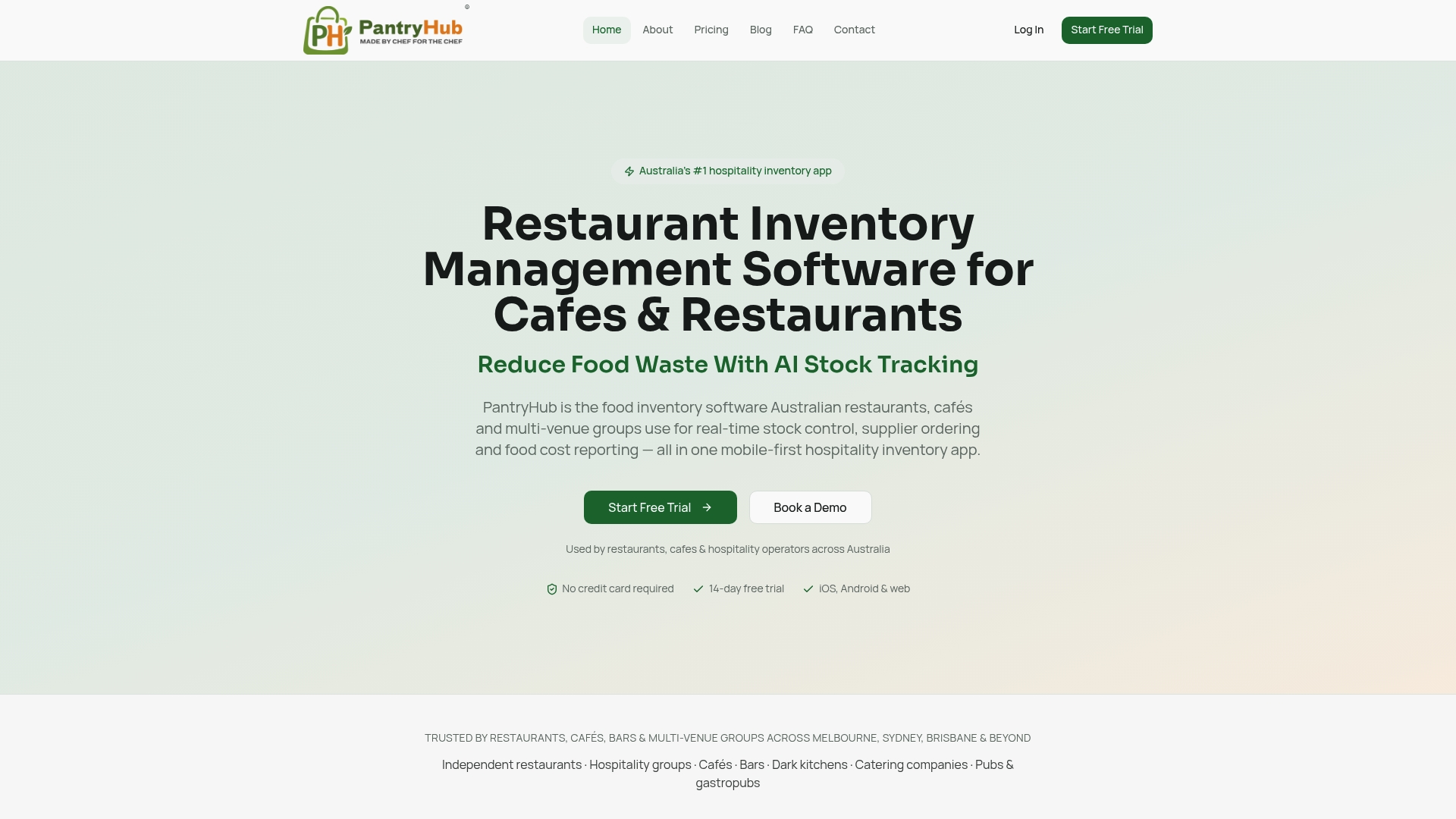
Built by a chef for chefs, Pantryhub gives franchisors the centralized catalog, low-stock alerts, and supplier ordering this guide describes, while still letting individual locations manage their day-to-day counts without friction. Reporting rolls up automatically, so you're not chasing spreadsheets from ten different managers every month. Plans start at A$39 per month, scaled to the number of venues you run, and you can explore the full feature set on the hospitality inventory platform page before committing. If your network is still stitching together spreadsheets and phone calls, start a free trial and see what a single source of truth looks like across your locations.
Sources
- The Unique Challenges of Franchise Inventory Management | Agiliron
- Franchise OMS: Unified Inventory & Fair Sourcing | OneStock