

Inventory visibility is the ability to see and manage stock instantly and accurately across all restaurant or hospitality locations from one central system. For multi-site operators, this is not a convenience. It is the foundation of every purchasing decision, every stock transfer, and every service promise you make to a guest. The role of inventory visibility in multi-site operations determines whether your locations run as a coordinated network or as isolated units burning cash on duplicate orders and emergency restocks. Industry analyses show that businesses adopting centralized visibility systems reduced storage and capital costs by 20–30% while maintaining inventory accuracy above 99%.
What role does inventory visibility play in multi-site operations?
Inventory visibility in multi-site hospitality means every location's stock data feeds into one central system in real time. A manager in Sydney can see what the Melbourne venue has on hand, what is in transit, and what needs reordering before a service gap appears. That level of coordination is what separates a profitable restaurant group from one that bleeds margin on preventable waste and stockouts.
The industry term for this capability is "centralized inventory management," and it sits at the core of modern supply chain practice. Store-level visibility is now a core supply chain requirement, turning individual locations into integrated fulfillment nodes rather than independent profit centers. That shift in thinking changes how you staff, purchase, and plan across your entire group.

Without this foundation, multi-site inventory management becomes a guessing game. You are reacting to problems instead of preventing them. Real-time, centralized tracking gives you the data to act before a stockout hits a Friday dinner service or an overstock of perishables drives up your food cost percentage.
What challenges do multi-site hospitality operations face without proper inventory visibility?
Poor visibility creates a cascade of operational failures that compound across every location you run. The problems are predictable, expensive, and almost entirely avoidable.
Research confirms that missing real-time multi-site visibility leads to missed internal stock transfers, unnecessary purchasing, and data inaccuracies that make manual spreadsheets useless. A spreadsheet updated once a day at one location tells you nothing about what another venue used during the lunch rush. By the time the data is reconciled, the damage is done.
The most common failure points operators face include:
- Siloed data. Each location tracks stock independently, so no one has a complete picture. Purchasing decisions get made on incomplete information.
- Spreadsheet reliance. Manual entry creates errors. A miskeyed quantity or a forgotten update creates a "data black hole" where transitioning to multi-site operations demands fundamental model changes that spreadsheets cannot support.
- Duplicate purchasing. Without visibility into what other sites hold, managers order stock that already exists elsewhere in the group. That ties up cash and inflates storage costs.
- Delayed updates. End-of-day counts mean your data is always hours behind reality. In a busy kitchen, that lag costs you.
- Missed stock transfers. Excess stock at one venue and a shortage at another go unresolved because no one can see both problems at once.
67% of supply chain leaders plan to improve inventory visibility, but only 30% have made substantial progress. That gap explains why so many multi-site groups still struggle with bloated inventory and missed service levels despite knowing the problem exists.
Pro Tip: Before blaming your team for stock discrepancies, audit your data collection process first. Most errors trace back to inconsistent input methods, not careless staff.
How does real-time, centralized visibility benefit multi-site restaurant businesses?
Centralized, real-time inventory data changes how your entire operation functions. The benefits are concrete and measurable, not theoretical.
-
Stock accuracy above 99%. Centralized visibility systems deliver inventory accuracy rates above 99% and reduce storage and capital costs by 20–30%. That accuracy means your purchasing reflects reality, not guesswork.
-
Faster internal stock transfers. When you can see that Location A has surplus chicken stock and Location B is running low, you can move product between venues before either location has a problem. That single capability eliminates a significant source of emergency purchasing.
-
Reduced labor waste. Effective visibility cuts emergency shipping fees and labor waste by eliminating manual reconciliations and the phone calls that go with them. Your team spends time cooking and serving, not chasing stock counts.
-
Better demand forecasting. When sales data and inventory data live in the same system, you can see patterns across all venues. A product that moves fast at one location on weekends becomes a purchasing signal for the whole group.
-
Consistent guest experience. A guest who visits your venue in one city expects the same menu availability as your other locations. Centralized tracking makes that consistency achievable because you can see and respond to stock gaps before service.
Real-time visibility shifts operations from reactive to proactive. That shift is the difference between managing a crisis and preventing one. For hospitality operators, where margins are thin and guest expectations are high, proactive management is not optional.
Pro Tip: Connect your inventory system to your POS data. When sales and stock data update together, your reorder points become accurate instead of approximate.
What are best practices for implementing multi-site inventory visibility?
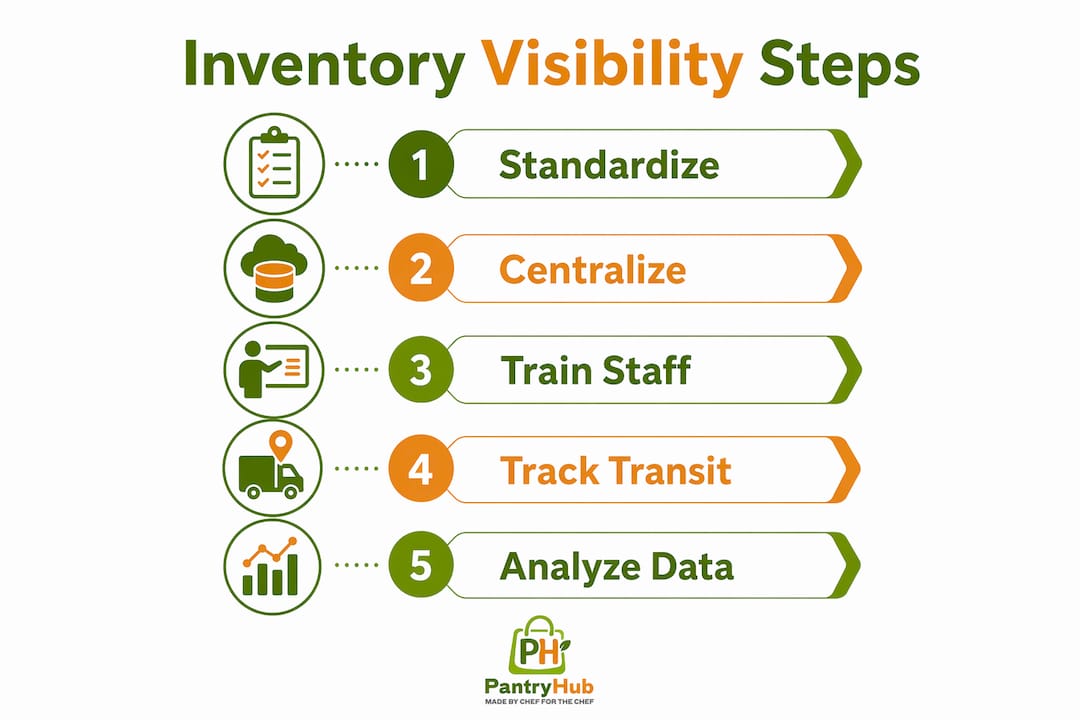
Implementation fails more often from process gaps than from technology gaps. The biggest implementation mistake is lacking a standardized SOP before system rollout. Technology cannot fix inconsistent inputs. Get your processes right first, then deploy the software.
Standardize before you digitize
Every location must use the same SKU codes, unit of measure, and update frequency before a single screen goes live. Failing to standardize SKUs, update frequencies, and reporting formats before implementation causes inconsistent data and operational breakdowns. A product called "chicken breast 2kg" at one venue and "chkn bst" at another creates reporting chaos that no software can resolve automatically.
Build a Single Source of Truth
Without a Single Source of Truth architecture, inter-site transfers and enterprise-level planning become impossible, causing stuck inventory and stockouts. A centralized inventory management system with real-time syncing and audit trails gives every manager access to the same data at the same time. No version conflicts. No outdated counts.
Write SOPs for every stock movement
Your team needs documented procedures for receiving stock, recording transfers, conducting counts, and flagging discrepancies. Without SOPs, each location develops its own habits, and those habits produce incompatible data. Cover these processes at minimum:
- Receiving and logging new stock deliveries
- Recording inter-site stock transfers with quantities and timestamps
- Conducting scheduled cycle counts and full stocktakes
- Escalating discrepancies above a defined threshold
Train staff on consistent data entry
A system is only as accurate as the data your team puts into it. Train every staff member who touches inventory on the exact input method your system requires. One person entering quantities in grams while another uses kilograms breaks your entire reporting chain.
Pro Tip: Run a parallel test period where your team uses the new system alongside your old process for two to four weeks. This catches input errors before they corrupt your baseline data.
Track stock in transit
Inter-site transfers create a visibility gap if your system does not account for stock that has left one location but not yet arrived at another. Build transit tracking into your SOP so stock in a delivery vehicle appears in your system as "in transit" rather than simply disappearing from one count and appearing in another.
How can multi-site managers use inventory visibility for growth?
Visibility data is most powerful when managers treat it as a planning tool, not just a reporting tool. Managers who treat locations as integrated planning nodes maintain forecasting accuracy and avoid inventory degradation across the group.
The practical applications for growth-focused operators include:
- Dashboard monitoring. A real-time dashboard showing stock levels, reorder points, and transfer status across all venues gives you a daily operational picture without calling each location.
- Internal reallocation. Spot surplus stock at one venue and redirect it to a higher-demand location before it becomes waste. This is one of the fastest ways to cut food cost percentage.
- Supplier negotiation. Consolidated purchasing data across all venues gives you volume leverage. When you can show a supplier your total spend across five locations, you negotiate from a position of strength.
- New location planning. Opening a new venue is less risky when you have accurate demand data from existing locations. You can set opening stock levels based on real sales patterns rather than estimates.
- Supply chain model decisions. Visibility data reveals which suppliers consistently cause delays or quality issues. That evidence supports decisions to change suppliers or consolidate orders.
For operators considering multi-location stock management, the shift from location-by-location thinking to network thinking is the most valuable mindset change visibility enables. You stop asking "what does this venue need?" and start asking "how does the whole group perform?"
Key takeaways
Centralized, real-time inventory visibility is the single most effective tool multi-site hospitality operators have for reducing costs, preventing stockouts, and building a consistent guest experience across every location.
| Point | Details |
|---|---|
| Visibility reduces costs | Centralized systems cut storage and capital costs by 20–30% while keeping accuracy above 99%. |
| Standardize before deploying software | Consistent SKUs, units, and SOPs must exist before any system goes live. |
| Real-time data enables proactive management | Live stock data lets you transfer inventory and reorder before a service gap occurs. |
| Siloed data is the core enemy | Without a Single Source of Truth, inter-site transfers and forecasting both fail. |
| Visibility supports growth decisions | Consolidated data across venues informs supplier negotiations and new location planning. |
Why visibility changed how I think about running multiple venues
The operators I see struggle most with multi-site inventory are not the ones with bad technology. They are the ones who digitized a broken process. They took their spreadsheet habits, loaded them into a new system, and wondered why the numbers still did not add up.
The shift that actually works is treating your locations as one operation with multiple service points, not as separate businesses that happen to share a name. That sounds obvious, but it requires a real change in how you structure purchasing authority, how you report on stock, and how you hold each venue accountable to the same data standards.
Real-time visibility did not just give me better numbers. It changed the conversations I had with my team. Instead of debating whose count was right, we were discussing why demand spiked at one venue and how to position stock ahead of the next weekend. That is a fundamentally different and more productive use of everyone's time.
The technology matters, but the process discipline matters more. I have seen well-funded groups fail at multi-site inventory because they skipped the SOP work. I have also seen lean operations with modest software run tight, accurate stock across six venues because their team followed consistent procedures every single day. Get the process right. Then let the technology do what it is built to do.
For operators ready to take real-time inventory tracking seriously, the starting point is always the same: audit your current data inputs before you buy anything new.
— Admin
Pantryhub gives multi-site operators full inventory control
Multi-site hospitality operators need a system built for the complexity of running multiple venues, not a single-site tool stretched to fit. Pantryhub is designed specifically for restaurants, cafés, bars, and commercial kitchens that need centralized, real-time stock visibility across every location they run.
Pantryhub's platform includes real-time inventory dashboards, low-stock alerts, inter-site stock transfer tracking, audit trails, and supplier integration. Every feature addresses the operational gaps that cost multi-site groups money: duplicate orders, missed transfers, and data that is hours out of date. If you are ready to move from reactive to proactive inventory management, Pantryhub's hospitality inventory software gives your whole team a single, accurate view of stock across every venue, updated in real time.
FAQ
What is inventory visibility in multi-site hospitality?
Inventory visibility in multi-site hospitality is the real-time, centralized tracking of stock levels, locations, and movements across all venues from one system. It gives operators a single, accurate view of what every location holds at any moment.
Why do multi-site restaurants struggle with inventory accuracy?
Most multi-site restaurants struggle because each location tracks stock independently using spreadsheets or disconnected systems. Siloed data causes missed transfers, duplicate purchasing, and counts that are always behind actual usage.
How much can centralized inventory visibility reduce costs?
Centralized visibility systems reduce storage and capital costs by 20–30% while maintaining inventory accuracy above 99%. Those savings come from eliminating duplicate orders, reducing emergency purchasing, and cutting labor spent on manual reconciliations.
What should operators do before implementing inventory software?
Operators must standardize SKU codes, units of measure, and update frequencies across all locations before deploying any software. Lacking standardized SOPs before rollout is the most common reason implementation fails.
How does inventory visibility support opening new restaurant locations?
Real-time data from existing venues gives operators accurate demand benchmarks for setting opening stock levels at a new location. It also reveals which suppliers and supply chain models perform best across the group, reducing the risk of a new opening.