
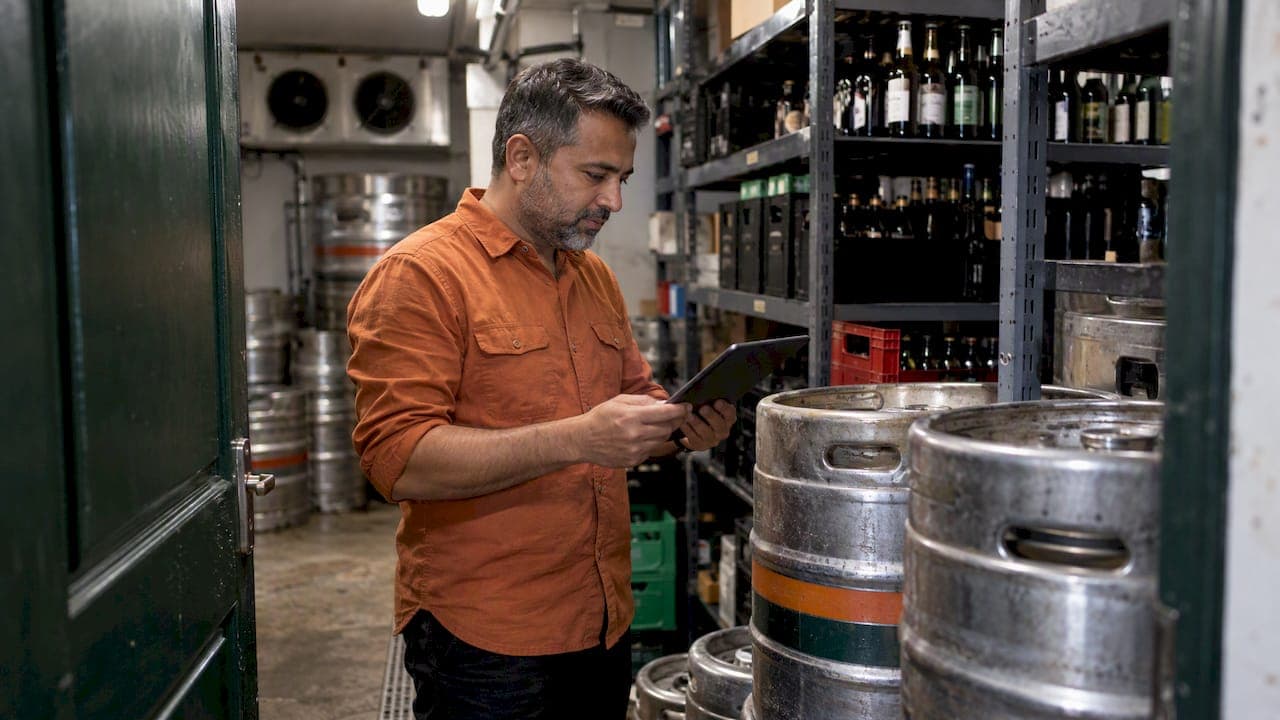
AI inventory management is software that learns from your stock counts, sales and supplier orders, then tells you what to order, when, and where stock is leaking. For a restaurant, café, pub or club, the practical payoff is simple: fewer emergency supplier calls, less food in the bin, and a food cost percentage you can trust. This guide covers what it actually does, what it costs in Australia, where it falls short and how to start.
TL;DR
- AI inventory management turns your counts, sales and orders into alerts and ordering suggestions, so you stop relying on gut feel and spreadsheets.
- The most valuable use is predictive: knowing what you will need, not just what you have. Counting alone is the entry point.
- Australian venues commonly pay $100 to $300 a month for AI inventory and food cost tools. PantryHub plans run from A$39 to A$99 a month.
- You stay responsible for what the software orders. Keep a human check on big purchases and lock down logins.
- Start with one category, such as proteins or dry goods, and expand once the numbers hold.
Table of Contents
- What AI inventory management means in a kitchen
- Why it matters: the cost of not knowing
- What AI actually does for your stock
- A simple way to judge the benefit
- What it costs in Australia
- Where AI inventory tools fall short
- How to roll it out without disrupting service
- Who is adopting it
- Our perspective: start with visibility, then add intelligence
- Try it in your own kitchen
- FAQ
- Sources
What AI inventory management means in a kitchen
Forget warehouse robots. In hospitality, AI inventory management is a few plain jobs done well and done continuously:
- Tracking usage. Comparing what you bought, what you counted and what you sold, so variances show up quickly.
- Flagging low stock. Alerts that fire against your par levels, not after the walk-in is empty on a Friday.
- Suggesting orders. Turning current stock and recent usage into a supplier-ready order.
- Spotting patterns. Showing which items are over-ordered, which dishes drive waste and which suppliers creep up on price.
The difference from a spreadsheet is that the system keeps learning and does the arithmetic for you. A spreadsheet only knows what you typed on the last count day.
Why it matters: the cost of not knowing
Food waste is the most visible symptom of weak inventory control. Calso's analysis of Australian venues puts the cost at roughly $10,000 to $25,000 a year for an average restaurant, with mid-sized venues wasting 25 to 30 percent of the food they buy. Treat those as industry estimates, not a guarantee for your venue, but the direction is hard to argue with.
The cause is rarely lazy staff. The Café Sector Action Plan report found that overstocking to avoid ever running out is likely to generate waste, and that long menus add stock control, ordering and labor load on top. Lack of visibility is the root problem. Venues often skip tracking waste because it feels complicated, yet recording it alongside real-time sales data is the most reliable way to find hotspots in menu design and over-ordering.
That is the quiet margin leak: a few cases of produce here, an extra tray of prep there, a price rise nobody noticed. None of it looks dramatic on any single day.

What AI actually does for your stock
Low-stock alerts and par levels
This is where most venues should start. You set a par level for each item. The system compares live stock against it and warns you before you run short. AI-powered alerts improve on a fixed threshold because the right par level on a wet Tuesday in July is not the right one for a long weekend or a footy final.
Demand forecasting
Forecasting is the other big search topic around this subject, and it is the most ambitious use. The idea is to predict covers and dish sales from history, season, weather and events, then work back to ingredient needs. Operators are advised to favor AI that solves predictive problems rather than reactive ones, linking forecasts to ordering so sales data feeds the next purchase decision.

Be realistic. Forecasts are only as good as your data. A venue with six months of clean sales and counts will get far more from forecasting than one that counts stock twice a year. Plenty of independents get most of the benefit simply from accurate counts, sensible pars and fast ordering.
Inventory optimization
Optimization is the tidy-up layer. It asks: which items sit too long, which are ordered in sizes that do not match usage, and where would a different pack size or supplier cut cost? It needs the same foundation: accurate usage data and recipes costed properly.
Waste and cost reporting
Reporting closes the loop. When you log waste and compare actual usage against what sales say you should have used, you see theoretical versus actual food cost. Our own guide on restaurant waste tracking walks through the practical steps.
A simple way to judge the benefit
Industry benchmarking cited by Calso suggests these tools can help operators reclaim 3 to 6 percentage points of food cost, against an industry norm of 28 to 35 percent of revenue. Those are benchmarks, not promises. Here is a way to test the math for your own venue using your own figures.
- Take your monthly food revenue.
- Multiply it by your current food cost percentage. That is your monthly spend on food.
- Work out what one percentage point of revenue is in dollars.
- Compare that figure with the subscription price.
A venue turning over $60,000 a month in food sales gives up $600 for every percentage point of food cost. Even a modest improvement dwarfs a subscription in the A$39 to A$99 range. If one point of food cost is worth less than the monthly fee for your venue, software is probably not your priority yet.
What it costs in Australia
Across categories of AI tools, Calso reports a range of $50 to $800 or more a month, with most independent cafés and restaurants landing lower in that range. For inventory and food cost platforms specifically, it points to $100 to $300 a month for independent venues.
When you compare quotes, look past the headline number:
| Question | Why it matters |
|---|---|
| Is it priced in AUD, with GST handled? | Avoids exchange-rate swings and messy BAS reporting. |
| Is pricing per venue or per user? | Per-user pricing grows quickly with a large team. |
| Does it connect to your Australian suppliers? | Ordering is where the time saving is. |
| Is there local support in your time zone? | Problems hit during service, not US business hours. |
| Does it work on a phone? | Counts happen in the cool room, not at a desk. |
| Can you try it before paying? | Your kitchen is the only real test. |
Where AI inventory tools fall short
Honest limits save you money and disappointment.
- Bad inputs, bad outputs. If recipes are not costed or counts are skipped, suggestions will be wrong. Software will not fix a process nobody follows.
- Menu changes. A new special or a supplier substitution can throw off predictions until the data catches up.
- Local events and weather. A sudden heatwave or a nearby event still needs your judgment.
- Accountability. Legal commentary on AI tools notes that owners remain responsible for what their tools do. Automating tasks does not remove liability under Australian Consumer Law, and retailers are advised to add human hand-offs for high-stakes decisions such as financial commitments. In a kitchen, that means a manager approves large or unusual orders before they go out.
Security basics before you connect anything
Many venues have weak password habits and no multi-factor authentication on business email. Reporting on Australian small business notes that using AI tools without basic security controls makes you a target for data theft and scams, and you remain responsible for breaches whichever platform you use. Turn on multi-factor authentication, give each team member their own login and limit who can place orders. Role-based team access is one reason to choose a platform built for kitchens.
How to roll it out without disrupting service
A staged approach works better than switching everything on at once.
- Pick one category. Proteins or dry goods are good first choices: high spend, easy to count.
- Build your item list and pars. Use your last few invoices as the source. Be ruthless about what is really on the shelf.
- Cost your recipes. Standardized recipes and prices are what make usage and food cost meaningful.
- Count weekly for a month. Let the system build a baseline and watch the variances.
- Turn on alerts. Adjust pars after two or three weeks, once you see how fast things actually move.
- Connect ordering. Send orders to suppliers from the same place you counted.
- Add the rest. Bring in more categories, locations and team members once the first one is steady.
If you are comparing options for a small venue, our guide to inventory software for small Australian venues and our roundup of restaurant inventory systems lay out the criteria in more detail.
Who is adopting it
As of April 2026, AI adoption in Australian hospitality sits at about 38 percent, behind finance and property services but growing, with rostering, bookings and inventory management the main focus. That gap is an opening. The venues that tighten stock control now are competing against operators still ordering from memory.
Our perspective: start with visibility, then add intelligence
PantryHub was built by a chef for chefs, and we have seen the same pattern in kitchens of every size. Operators hear "AI" and picture a forecasting engine that runs the whole business. What they actually need first is a reliable picture of what is on the shelf, what just came in and what went out.
That is why we built PantryHub around real-time stock tracking, AI-powered low-stock alerts, supplier ordering, recipe and pricing standardization, and waste and cost reporting. Team access controls keep the right people in charge of counts and orders, and multi-location inventory management lets groups see every site in one place. We price in AUD, report in a GST-ready way, offer local support and design for the phone, because that is where kitchen work happens.
Our view: get counts, pars and ordering right, and the "intelligence" has real data to work with. Chasing forecasting before you have that is how venues end up paying for dashboards nobody trusts. And whatever software you choose, a human should stay in the loop for decisions that commit real money.
— Admin
Try it in your own kitchen
PantryHub plans are published at Starter A$39, Regular A$69 and Pro A$99 per month, so you can match the plan to your venue count and the features you need. You can start a free trial and run a first category count before you commit. If you would like a walkthrough for your type of venue, see our hospitality inventory software page, or the local pages for Melbourne, Sydney and Adelaide.
FAQ
Is AI inventory management worth it for a small café or pub?
Often yes, if food and drink cost is a large share of your spend and you currently count by hand or not at all. Work out what one percentage point of food cost is worth to you each month and compare it with the subscription. If the saving is clearly larger, it is worth testing on a free trial first.
How is AI demand forecasting different from low-stock alerts?
Alerts react to what is on the shelf now, against a par level you set. Forecasting predicts what you will sell and need in the days ahead, using sales history and patterns. Alerts are the easier starting point, and forecasting works best once you have clean data built up.
Can AI place orders for me automatically?
Some tools can suggest or generate supplier orders when stock hits reorder levels. You remain responsible for the outcome, so it is sensible to have a manager review large or unusual orders before they are sent.
How long before I see results?
Expect a few weeks to build a baseline of counts and variances. Pars and alerts usually need a couple of adjustments before they match how your kitchen really runs. Savings depend on your starting point, so track food cost percentage before and after.
Sources
- How Much Does AI for Hospitality Cost in Australia? (Calso)
- How to Reduce Food Waste in Restaurants: 2026 Best Practices (Calso)
- Café Sector Action Plan Report 2024
- How Restaurants Use AI to Cut Food Waste and Costs
- Why retailers can't escape responsibility for AI chatbots (Inside Retail Australia)
- Australian small businesses face rising cyber pressure as AI scams outpace basic defences
- AI adoption for Australian small business 2026