

Effective inventory management during public holidays in Australia is defined as the process of aligning stock levels, supplier orders, and staff scheduling to meet predictable demand spikes without generating excess waste or lost sales. Australian hospitality managers face a distinct challenge: the country's public holiday calendar clusters high-demand periods in march, april, and october, creating wage cost spikes and supply pressure simultaneously. The Fair Work Act and recent 2026 Federal Court rulings add compliance obligations that directly affect how you roster staff and budget for peak periods. Pantryhub's hospitality inventory platform is built specifically to help restaurants, cafés, and bars navigate these pressures with real-time stock visibility and automated reorder alerts.
How to manage inventory for public holidays in Australia
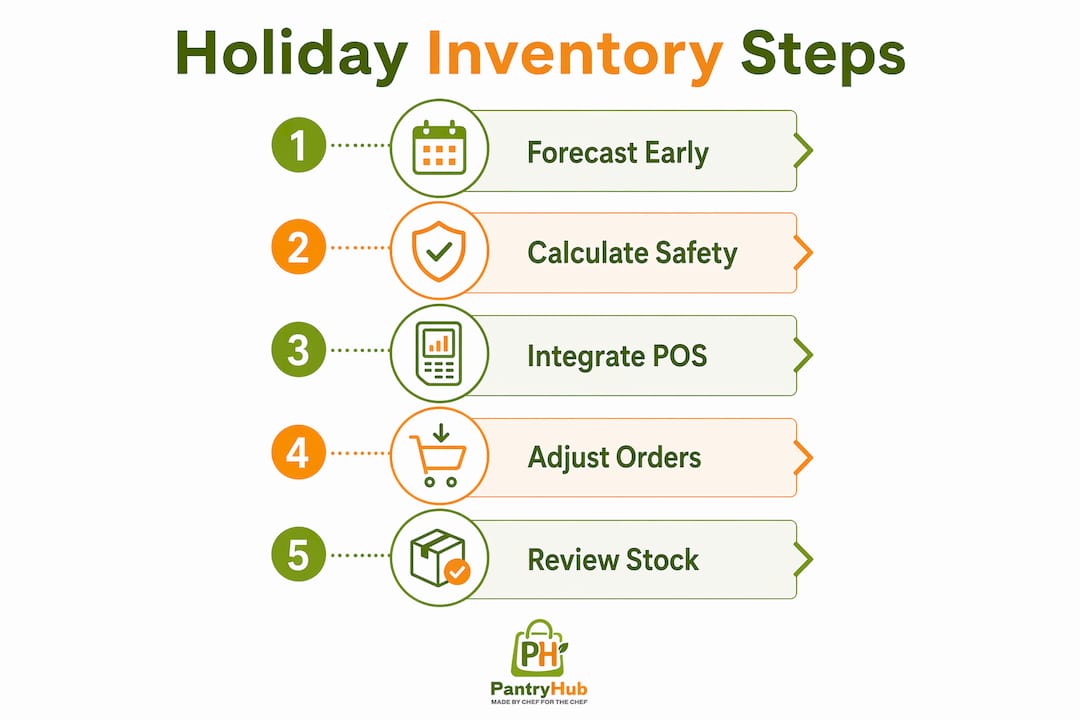
The single most effective starting point is pulling last year's point-of-sale data for the same holiday period. Relying on memory for seasonal orders leads to errors that cost you sales or saddle you with waste. Your POS system holds the objective truth about what sold, when, and in what volume.
Forecasting works best when you segment your stock into three tiers:
- Hero SKUs: Your top revenue drivers. These need the closest attention and the highest safety stock buffers.
- Secondary SKUs: Solid performers that support the menu but are easier to substitute if supply runs short.
- Tail SKUs: Low-volume items. Carry minimal buffer and consider cutting them from the holiday menu entirely.
Experts recommend building baseline forecasts 12–16 weeks before major holiday peaks, focusing on your top 20% of SKUs with 15–20% safety stock buffers. That lead time gives you room to negotiate supplier terms and avoid last-minute premium pricing.
Promotional events compound the forecasting challenge. If you are running a holiday set menu or a special event, promotional campaigns can multiply baseline demand by 3–10 times. Add a 25–30% buffer specifically for bundled or promotional items to prevent stockouts during your highest-revenue windows.

Pro Tip: Connect your POS system to your inventory platform so that sales data feeds directly into reorder calculations. Manual data entry at peak times introduces errors that compound quickly.
What are the best safety stock levels for holiday peaks?
Safety stock is the buffer quantity you hold above your expected demand to cover supply delays or demand surges. The right level is not a flat percentage applied across all products. Calculate safety stock per SKU tier using demand standard deviation and supplier lead time rather than a blanket rule.
The standard formula is: Safety Stock = Z-score × Standard Deviation of Demand × Square Root of Lead Time. For hospitality, a Z-score of 1.65 covers 95% of demand variability scenarios. A 20% buffer may be too thin for a high-volatility Hero SKU with a five-day lead time, and too generous for a Tail SKU you reorder weekly.
| SKU Tier | Recommended Buffer | Lead Time Assumption | Key Risk |
|---|---|---|---|
| Hero | 20–25% above forecast | 5–7 days | Stockout during peak service |
| Secondary | 15–20% above forecast | 3–5 days | Menu substitution required |
| Tail | 5–10% above forecast | 1–3 days | Overstock and waste |
Understocking a Hero SKU during a public holiday weekend costs you revenue and damages the guest experience. Overstocking a Tail SKU ties up cash and generates food waste. Both outcomes are preventable with tier-specific calculations.
Pro Tip: Review your safety stock levels at least four weeks before each public holiday. Supplier lead times often extend during peak periods, which means your standard buffer may not be sufficient.
For managers running multiple venue locations, safety stock calculations need to account for each site's individual sales patterns rather than averaging across the group.
How do 2026 Australian public holiday labor laws affect inventory planning?
The 2026 Federal Court ruling changed the rules for rostering staff on public holidays. Automated rostering without explicit staff requests may now breach the Fair Work Act. Employers must formally request employee availability before scheduling public holiday shifts, and that request must be documented.
This matters for inventory planning because your operational capacity on a public holiday directly determines how much stock you can move. If you cannot confirm your full team, you cannot commit to a full service volume. Ordering for a 200-cover day when you can only staff 120 covers creates waste.
Key compliance points for 2026 rostering:
- Document every availability request and staff response before publishing the roster.
- Check your applicable Modern Award for substitution rules. Some Awards allow a public holiday to be substituted for another day, which shifts your peak demand date.
- Some Awards disallow stacking Sunday penalty rates with public holiday rates. Confirm this before budgeting labor costs for any Sunday public holiday.
- Wage cost clusters in march, april, and october. Budget for these spikes separately rather than spreading labor costs evenly across the year.
Payroll accuracy on public holidays is not just a compliance issue. An underpaid or incorrectly rostered employee creates a Fair Work Ombudsman complaint risk that costs far more to resolve than the original wage error.
Integrating your confirmed staff headcount into your inventory order quantities is the practical link between labor compliance and stock management. Fewer confirmed staff means a reduced service capacity, which means a lower order volume.
What operational strategies reduce waste during Australian public holidays?
Waste during public holidays comes from two sources: over-ordering because you guessed wrong, and under-utilizing stock because service ran shorter than expected. Both are controllable.
Outsourcing stocktaking before and during peak holiday windows improves accuracy and frees your internal team to focus on service. Trained stocktaking teams count faster and more accurately than kitchen staff pulled off the floor mid-shift.
Pre-assembling bundled items or holiday combos before service starts is another proven tactic. Pre-assembling combos reduces picking steps, cuts human error, and simplifies inventory tracking to a limited set of kits rather than dozens of individual components. A Christmas Eve set menu with three pre-built entrée kits is far easier to track than 15 separate ingredients moving in and out of stock simultaneously.
Additional tactics that work in practice:
- Set a markdown clearance plan for perishables three days before the holiday. Discounting slow movers before the holiday is better than discarding them after.
- Avoid offering next-day delivery or same-day catering commitments during peak periods when your prep bandwidth is already stretched. Transparency about lead time capacity protects your reputation.
- Use automated reorder triggers set at your calculated safety stock threshold so that replenishment orders fire without manual intervention.
- Conduct a digital stocktake two days before the holiday to confirm actual on-hand quantities match your system records.
The combination of pre-holiday stocktaking, pre-assembled service kits, and automated reorder points removes most of the reactive decision-making that causes waste.
Which tools support inventory management during Australian public holidays?
The right technology removes the manual work that breaks down under pressure. For hospitality managers, the core requirement is a platform that connects POS sales data, supplier lead times, and stock levels in one place.
Mobile stock management apps let your team count and update stock from anywhere in the venue, not just from a desktop in the back office. Real-time accuracy matters most when you are 48 hours out from a public holiday and need to confirm whether your order quantities are correct.
Key features to look for in hospitality inventory software:
- Automated low-stock alerts triggered at your safety stock threshold, not just when you run out.
- POS integration that pulls actual sales data into reorder calculations automatically.
- Multi-location stock synchronization so that a venue running low can draw from another site's surplus before placing a new supplier order.
- Supplier lead time tracking that adjusts reorder points when a supplier's delivery window extends during peak periods.
- Compliance-aware scheduling support that flags rostering conflicts with Fair Work Act requirements before the roster is published.
| Feature category | Benefit during public holidays |
|---|---|
| Automated reorder alerts | Prevents stockouts without manual monitoring |
| POS-linked forecasting | Grounds orders in actual sales data, not estimates |
| Multi-location sync | Redistributes surplus stock before ordering new supply |
| Lead time tracking | Adjusts buffers when suppliers slow down |
| Digital stocktake tools | Confirms on-hand accuracy before peak service |
Platforms built specifically for hospitality inventory in Australia account for the local public holiday calendar, Award-based labor costs, and the perishable nature of food and beverage stock. Generic retail inventory tools do not carry those assumptions.
Key Takeaways
Effective holiday inventory planning in Australian hospitality requires tier-specific safety stock calculations, POS-driven forecasting, and documented Fair Work Act compliance before the roster is published.
| Point | Details |
|---|---|
| Forecast 12–16 weeks out | Build baseline orders from last year's POS data, not memory, for the same holiday period. |
| Tier your safety stock | Apply 20–25% buffers to Hero SKUs and lower buffers to Tail SKUs based on lead time and demand variance. |
| Comply with 2026 rostering rules | Document staff availability requests before publishing any public holiday roster to avoid Fair Work Act breaches. |
| Pre-assemble and outsource | Bundle holiday combos before service and outsource stocktaking to free your team for customer-facing work. |
| Use automated reorder triggers | Set reorder points at your safety stock threshold so replenishment fires without manual intervention. |
The part of holiday planning most managers skip
Most hospitality managers I talk to treat public holiday inventory as a logistics problem. Order more, hope for the best, deal with the waste afterward. That framing is the root cause of most holiday losses.
The real problem is that public holidays in Australia are compliance events as much as they are demand events. The 2026 rostering ruling changed the game in a way that many operators have not absorbed yet. If you cannot confirm your staffing before you confirm your orders, you are building your inventory plan on a foundation that may collapse 72 hours before service. I have seen venues order for a full Saturday night on Good Friday, only to find half their team unavailable because the availability request process was never completed.
The other thing I would push back on is the instinct to add a flat buffer across all products. A 20% buffer on your house wine makes sense. A 20% buffer on a specialty garnish that moves three units a week is cash sitting in a cool room doing nothing. Tier your buffers. Do the math per SKU. It takes an afternoon the first time and 20 minutes every quarter after that.
Technology does not replace judgment here. It removes the manual work so your judgment can focus on the decisions that actually matter, like which menu items to cut for a reduced holiday service, or which supplier to call when your primary one cannot deliver. Pantryhub gives you the data layer. You still make the calls.
— Admin
Pantryhub makes holiday stock planning easier for Australian hospitality
Running a café, restaurant, or bar through a public holiday period is demanding enough without chasing stock counts and supplier emails manually.
Pantryhub is built specifically for Australian hospitality, with POS-linked forecasting, automated low-stock alerts, real-time multi-location stock visibility, and supplier ordering tools that cut the manual work out of peak period preparation. Whether you manage a single kitchen or a group of venues, Pantryhub gives you accurate stock data and automated reorder triggers exactly when you need them most. Book a demo at pantryhub.com.au and see how it handles your next public holiday period before it arrives.
FAQ
How far in advance should I order stock for Australian public holidays?
Experts recommend building forecasts 12–16 weeks before major holiday peaks. That lead time allows for supplier negotiations and avoids last-minute premium pricing.
What safety stock buffer should I use for public holiday inventory?
Apply a 15–20% buffer to your top SKUs and calculate buffers for other tiers using demand standard deviation and supplier lead time. A flat percentage applied across all products leads to either stockouts or excess waste.
Do the 2026 Fair Work Act changes affect how I order inventory?
Yes. The 2026 Federal Court ruling requires documented staff availability requests before rostering public holiday shifts. Your confirmed staffing headcount directly determines your service capacity and therefore your order quantities.
Should I outsource stocktaking during public holiday periods?
Outsourcing stocktaking during peak periods is a recognized best practice. Trained stocktaking teams count faster and more accurately than kitchen staff, freeing your team for customer service during high-demand periods.
How does POS data improve holiday inventory planning?
POS data from the same holiday period in previous years gives you objective reorder benchmarks. Pulling last year's sales reports removes the guesswork that causes both stockouts and over-ordering during peak periods.