

Most bar owners know they're losing money somewhere. They just can't prove it. Understanding how bar inventory tracking works is the difference between guessing and knowing. A bottle of premium whiskey doesn't just disappear. It gets over-poured, comped without documentation, or walked out the back door. Simple counting tells you what's on the shelf. Real inventory tracking tells you what should be there, what isn't, and exactly why the numbers don't match.
Table of Contents
- Key takeaways
- How bar inventory tracking works: the core concepts
- The step-by-step bar inventory process
- Technology solutions for bar inventory tracking
- Common challenges in bar stock control
- My take on what actually changes when you track properly
- See how Pantryhub simplifies bar inventory
- FAQ
Key takeaways
| Point | Details |
|---|---|
| Counting alone isn't enough | You need variance analysis comparing theoretical usage to actual usage to catch real losses. |
| Par levels drive smart ordering | Setting par levels based on real usage data prevents both stockouts and over-ordering. |
| Consistency is everything | Counts done at the same time, in the same units, by the same method produce reliable data. |
| Technology closes the gap | Bar inventory software linked to your POS removes manual calculation errors and flags issues faster. |
| Variance is an early warning | Treat discrepancies as operational alerts, not just end-of-month accounting entries. |
How bar inventory tracking works: the core concepts
Before you can track anything accurately, you need a shared language across your team. That means consistent units, defined pour sizes, and clear targets.
Measurement units are the foundation. Whether you count by bottle, ounce, or case, every person doing a count must use the same unit every time. Mixing bottles with ounces across different count periods makes your data worthless.
Standard pour sizes are what connect your sales data to your physical stock. If your bar pours 1.5 oz of vodka per drink and you sold 200 vodka drinks last week, your theoretical usage is 300 oz. That's the number you compare against your physical count to find out if something went wrong.
Par levels are your target stock quantities. The formula is straightforward: par = usage during coverage period + buffer. If your bar goes through 10 bottles of rum in a week and you want a two-bottle buffer, your par is 12. Many operations fail par systems by using inconsistent definitions, so keep it strict and documented.
Reorder points tell you when to place an order, not just what to have on hand. Reorder point = usage during lead time + buffer. If your supplier takes two days to deliver and you use three bottles of gin per day, your reorder point is six bottles plus your safety buffer.
Variance is where the money conversation happens. It's the gap between what you theoretically used and what you actually used. Common variance causes include over-pouring, untracked comps, spills, and theft. A 3% variance on a $20,000 monthly liquor spend is $600 walking out the door every single month.

Pro Tip: Document your standard pour sizes in writing and post them where every bartender can see them. One bartender free-pouring 2 oz instead of 1.5 oz adds up to a 33% cost overrun on every drink they make.
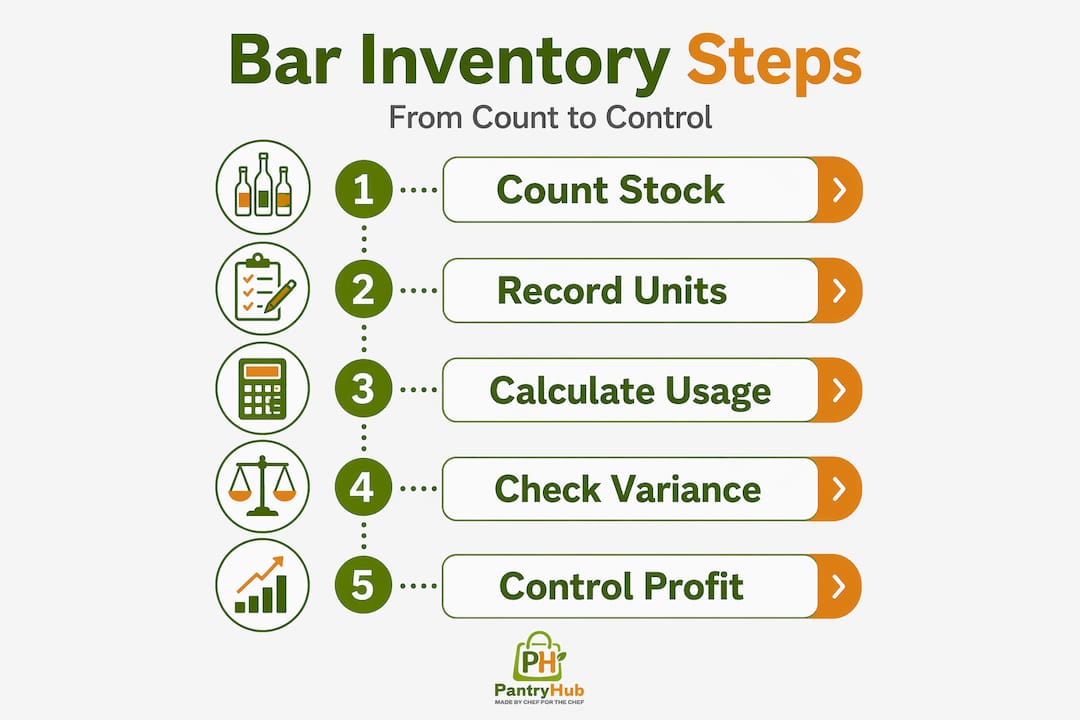
The step-by-step bar inventory process
Knowing the concepts is one thing. Building a repeatable process is what actually protects your margins. Here's how to track bar inventory in a way that produces reliable, usable data.
-
Set a counting schedule and stick to it. Weekly full counts are standard in well-run bars, with spot checks on high-value or high-velocity items in between. Consistency in timing matters as much as the count itself. Counting on Monday morning before deliveries arrive removes variables.
-
Count every bottle, including partials. Full bottles are easy. Partial bottles are where most operations get sloppy. Weighing partial bottles against the tare weight of an empty bottle gives you the most accurate ounce count. If scales aren't in your budget yet, use a consistent visual method: tenths of a bottle, marked on a reference sheet.
-
Record opening inventory, purchases, and closing inventory. Your actual usage calculation is: opening inventory + purchases received, minus closing inventory. If you skip recording deliveries accurately, your usage numbers will be wrong before you even start the analysis.
-
Calculate theoretical usage from your POS data. Pull your sales mix for the period, multiply each product by its standard pour size, and total it up. This is what you should have used if every pour was perfect and nothing was lost.
-
Compare actual to theoretical and calculate variance. A 7-step inventory workflow built around this comparison is the backbone of any serious bar operation. The variance percentage, not just the raw number, tells you whether a problem is growing.
-
Investigate variance causes immediately. Don't wait until month-end. Variance as an early warning system means checking the numbers weekly and asking why before small issues become large ones.
-
Adjust your orders based on real data. Once you have two or three weeks of reliable usage data, your ordering stops being guesswork. You order what you need, when you need it, at the right quantity to hit par without over-stocking.
Pro Tip: Always count in the same direction through your bar, every single time. Start at the same shelf, end at the same shelf. It sounds trivial, but it eliminates the "did I count that bottle twice?" problem that corrupts data.
Technology solutions for bar inventory tracking
Manual spreadsheets work. They just don't scale, and they don't catch errors in real time. Modern technology for bar inventory removes the calculation burden and gives you faster, cleaner insights.
Here's what the technology stack for a well-run bar typically looks like:
- Bar inventory software connects your physical counts directly to your sales data, automatically calculating variance at the product level. You enter the count; the software does the math. POS-integrated software enables pour-level tracking and flags discrepancies without you needing to build a single formula.
- POS integration is the piece that makes real-time tracking possible. Every sale updates your theoretical inventory automatically. By the end of a shift, you already know what your expected stock levels should be.
- Perpetual inventory systems take this further. Perpetual systems update continuously after every transaction, so your on-hand stock figure is always current. The catch is that they require regular physical counts to prevent system drift, where small errors compound over time.
- Barcode scanning speeds up physical counts and reduces transcription errors. Instead of writing down bottle names by hand, you scan and move on.
- Weighing scales for partial bottles are the single highest-accuracy tool for counting. They're inexpensive and pay for themselves quickly in data quality.
| Method | Accuracy | Speed | Cost |
|---|---|---|---|
| Manual spreadsheet | Moderate | Slow | Low |
| Inventory software with POS | High | Fast | Medium |
| Perpetual system + physical counts | Very high | Very fast | Medium-High |
| Barcode scanning + scales | Very high | Fast | Medium |
Software also handles par level alerts and reorder triggers automatically. Instead of manually checking whether you're running low on a product, the system tells you. That removes a daily mental load from your managers and reduces the risk of stockouts on a busy Friday night.
Common challenges in bar stock control
Even with a solid process and good software, you'll run into friction. Knowing where things go wrong helps you fix them before they cost you.
Over-pouring is the most common source of variance in bars that have otherwise clean operations. It's rarely intentional. Bartenders get busy, free-pour habits drift, and nobody notices until the numbers don't add up. Standard pour training, jigger use, and regular spot checks are your best tools here.
Untracked comps and spills create legitimate variance that looks like theft if you don't document it properly. Cause coding at the point of adjustment separates a genuine accident from a theft pattern. If your system shows 10 bottles of tequila unaccounted for and five of them were documented spills and comps, you're looking for two bottles, not ten.
- Establish a clear comp recording process at the POS level so every free drink has a paper trail.
- Create breakage codes for spills and glass breakage so they don't inflate your shrinkage figures.
- Check deliveries against invoices before stocking. A short shipment that goes unrecorded looks like theft when you count at week-end.
- Separate who counts from who adjusts. When the same person who made an error also corrects it in the system, your audit trail disappears.
Pro Tip: Review your top five highest-variance products every week, not every month. If a specific bottle is consistently off, that's a pattern worth investigating before it becomes a significant loss.
Regularly revisiting your par levels is also part of best bar inventory practices. A par set in January based on winter volume will over-stock you in a slow March and under-stock you heading into a summer rush. Treat par levels as living targets, not permanent fixtures.
My take on what actually changes when you track properly
I've worked with enough bar operations to know that the ones struggling most aren't short on effort. They're short on data. What I've seen change when a bar commits to disciplined inventory tracking isn't just the numbers. It's the conversations.
When you have weekly variance data, you stop having vague arguments about whether someone is over-pouring and start having specific ones. "This product was 8% over theoretical usage three weeks in a row" is a conversation you can actually resolve. Without the data, you're managing on instinct, and instinct doesn't hold up in a busy service environment.
What I've learned is that the technology matters less than the discipline. I've seen bars run tight operations on a spreadsheet and I've seen bars with expensive software still hemorrhaging product because nobody followed the process. The software makes it faster and more accurate, but it doesn't replace the habit of counting consistently and investigating promptly.
The bars that improve their margins fastest are the ones that treat managing bar stock levels as a weekly management responsibility, not a monthly accounting task. When variance is an operational alert rather than a report you file away, everything tightens up.
— Admin
See how Pantryhub simplifies bar inventory

Pantryhub is built specifically for hospitality operations that need more than a spreadsheet. The platform connects your physical stocktakes directly to your sales data, calculates pour cost and variance automatically, and sends low-stock alerts before you run out of your best-sellers. You get pour cost tracking and stocktake automation in one place, with reporting that shows you exactly where your losses are coming from.
Whether you run a single bar or multiple venues, Pantryhub's hospitality inventory software gives you real-time visibility across your entire operation. Set par levels, manage reorder points, and integrate with your existing POS without rebuilding your workflow from scratch. It's the kind of tool that pays for itself the first time it catches a variance pattern you would have missed.
FAQ
How does bar inventory tracking work?
Bar inventory tracking works by counting physical stock, comparing it to theoretical usage calculated from sales and standard pour sizes, and analyzing the variance to identify losses from over-pouring, waste, or theft.
How often should a bar do a full inventory count?
Weekly full counts are the standard for most bars, with spot checks on high-value items between counts to catch issues before they escalate.
What is variance in bar inventory?
Variance is the difference between how much product you theoretically used based on sales data and how much you actually used based on physical counts. It reveals shrinkage from over-pouring, comps, spills, and theft.
What is a par level in bar inventory?
A par level is your target stock quantity, calculated as usage during the coverage period plus a buffer. It tells you how much of each product you should have on hand at any given time.
Do I need software to track bar inventory?
You don't need software to start, but it significantly improves accuracy and speed. Software that integrates with your POS automates variance calculations and sends reorder alerts, removing the manual work that makes spreadsheet-based tracking error-prone at scale.