

Stock software, known in the industry as restaurant inventory management software, is the single most direct tool Sydney operators have to stop profit from quietly disappearing through spoilage, over-ordering, and manual counting errors. Sydney's hospitality market is one of the most demanding in Australia. High rents, volatile demand around events like ANZAC Day and Christmas, and close scrutiny from the Australian Taxation Office make guesswork expensive. Tools like Pantryhub, MarketMan, and Square Restaurant Inventory give operators real-time control over every ingredient, every order, and every dollar tied up in stock. This article explains exactly why Sydney restaurants need stock software and how to get the most from it.
Why Sydney restaurants need stock software to survive rising costs
Inventory management is a major profitability lever that touches food costs, cash flow, labor efficiency, and menu pricing at the same time. That means a weakness in stock control does not just show up in one line of your P&L. It spreads across the entire operation. Sydney operators face a compounding version of this problem. The city's high labor costs and commercial rents leave almost no margin for waste, and the Australian Taxation Office treats high food cost variance as a red flag for cash leakage, which can trigger audits.
The core problem is that most restaurants still rely on manual stock counts, spreadsheets, or gut instinct. These methods cannot keep pace with Sydney's demand swings. A busy Friday night in Surry Hills or a long weekend in Manly can clear your walk-in refrigerator faster than any spreadsheet can track. Stock software solves this by connecting your point-of-sale data directly to your ingredient inventory, so every dish sold automatically deducts the correct quantities from your stock levels.
The result is a live, accurate picture of what you have, what you need, and what is at risk of spoiling. That picture is what separates profitable Sydney restaurants from ones that are busy but still losing money.
How does stock software reduce food waste in Sydney kitchens?
Food spoilage is a direct cost, and Australian restaurants face spoilage and waste issues driven by climate conditions and holiday demand spikes that are difficult to predict without data. Stock software attacks this problem through several specific mechanisms.
- Real-time ingredient tracking: Every sale processed through your POS automatically reduces stock levels at the ingredient level. You know exactly how much salmon, cream, or basil you have right now, not what you counted three days ago.
- Waste logging and reporting: Staff can log spoilage directly in the system. Over time, this data reveals patterns, such as which items spoil most often and on which days, so you can adjust order quantities.
- Par level automation: You set a minimum stock level for each ingredient. When stock drops below that threshold, the system flags it or triggers a purchase order automatically.
- Demand forecasting for Sydney peak periods: Predictive demand forecasting software reduces waste and excess stock especially during ANZAC Day and Christmas, when Sydney operators often over-order because supplier delivery schedules do not align with actual demand.
The integration between POS and inventory is where the real accuracy comes from. Without it, you are comparing what you think you sold against what you think you have. With it, you are comparing verified sales data against live stock counts, and the variance between the two tells you exactly where product is going missing.
Pro Tip: Run a weekly variance report comparing theoretical usage (based on sales) against actual stock depletion. A consistent gap in any ingredient is a signal of either spoilage, portioning errors, or theft. Catching it early saves real money.

What are the financial and operational benefits beyond waste reduction?
The benefits of stock software extend well past cutting food waste. Poor inventory quietly erodes profits even on busy days, because without accurate data, purchasing decisions are based on memory rather than evidence. Here is where the financial gains compound quickly.
- Accurate menu costing: When every recipe is mapped to its ingredients and current supplier prices, you know the exact cost of every dish. That means you can price confidently and spot immediately when a supplier price increase is eating into your margin.
- Labor savings through automation: Automation eliminates manual inventory tasks, reducing the hours your team spends counting stock and chasing purchase orders. Those hours go back into service, training, or simply reducing overtime costs.
- Stronger supplier negotiations: Historical purchase data gives you leverage. You can show a supplier exactly how much you buy, how often, and at what price, then negotiate better terms based on volume or consistency.
- Multi-location visibility: Multi-location managers benefit from centralized dashboards that provide real-time insights across all venues. For a Sydney restaurant group operating in the CBD, Newtown, and Bondi simultaneously, this is the difference between managing by exception and managing by crisis.
- Cash flow control: Real-time syncing between POS and inventory prevents stockouts and helps you avoid tying up cash in excess stock that sits in your cool room for weeks.
The regulatory dimension matters here too. Sydney operators must maintain accurate food safety records and demonstrate consistent stock practices to satisfy both council health inspections and ATO requirements. Software creates an automatic audit trail that manual systems simply cannot produce.
Which features should Sydney restaurants look for in stock software?
Choosing the right system means matching features to your actual operation, not buying the most expensive platform available. The table below compares the key feature categories and what to look for in each.
| Feature | What to look for |
|---|---|
| POS integration | Native sync with Square, TapTouch, or your existing system |
| Invoice capture | Photo or email capture that auto-updates stock levels |
| Demand forecasting | Algorithms that factor in local events and seasonal patterns |
| Multi-location support | Centralized dashboard with per-venue reporting |
| Pricing | Transparent per-location cost, typically around $99 per month |
| Cloud access | Browser and mobile access so managers can check stock remotely |
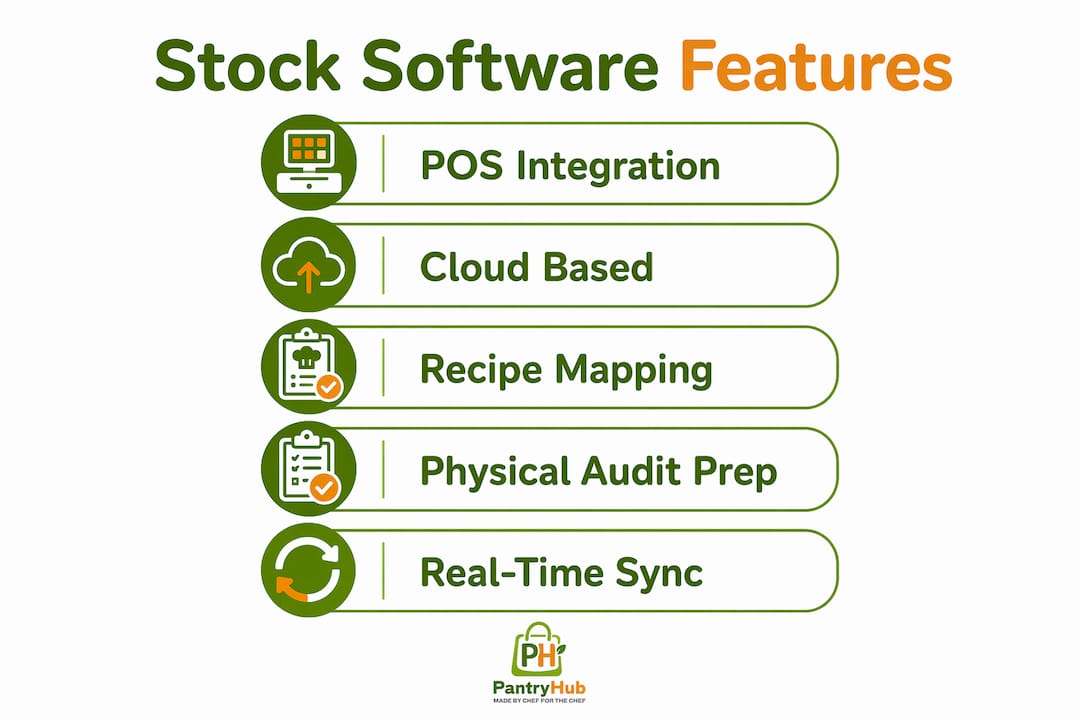
Cloud-based platforms are the clear choice for most Sydney operators. Cloud stock control software automates processes, improves stock valuation accuracy, and helps prevent both overstock and stockouts. On-premises systems require local servers, IT maintenance, and do not give you the remote access that a busy multi-site operator needs.
Recipe mapping is a feature that often gets overlooked during the buying decision but is critical to everything else working correctly. Before your system can track ingredient-level usage, every menu item must be linked to its exact components and quantities. This initial setup takes time, but it is the foundation of reliable data.
Pro Tip: Before going live with any stock software, conduct a full physical audit of your current inventory and map every menu item to its ingredients. Skipping this step means your system starts with bad data, and bad data produces reports you cannot trust.
For a detailed comparison of platforms suited to the Australian market, the food inventory software guide from Pantryhub covers local pricing, integrations, and feature differences in depth.
What pitfalls must Sydney operators avoid when implementing stock software?
Implementation failures are common, and most of them trace back to the same root causes. Knowing these in advance puts you ahead of the majority of operators who struggle with adoption.
- Garbage in, garbage out: Without correct recipe mapping, variance reporting becomes unreliable and undermines trust in your inventory data entirely. If your system thinks a pasta dish uses 150g of pasta when it actually uses 200g, every report built on that figure is wrong.
- Ignoring supplier delivery timing: Sydney operators who over-order around public holidays often do so because their software is not calibrated to local supplier schedules. If your produce supplier does not deliver on public holidays, your par levels need to account for that gap.
- Skipping POS integration: Running inventory software without connecting it to your POS means you are still entering sales data manually. This defeats the purpose and reintroduces the human error you were trying to eliminate.
- Failing to train the whole team: A system is only as accurate as the people using it. If kitchen staff are not logging waste, and front-of-house staff are not processing voids correctly, your data degrades fast.
- Not reviewing reports regularly: Software generates data, but data only creates value when someone acts on it. Schedule a weekly review of variance reports, waste logs, and purchase order history. Make it a fixed part of your management routine.
The perpetual inventory approach, where stock levels are updated continuously rather than through periodic counts, is the gold standard for busy Sydney kitchens. It requires discipline from the team but delivers the most accurate picture of your operation.
Key takeaways
Stock software is the most direct tool Sydney restaurant operators have to protect margins, reduce waste, and maintain compliance in a high-cost, high-scrutiny market.
| Point | Details |
|---|---|
| Profitability protection | Inventory software tracks actual vs. theoretical usage, exposing where profit disappears. |
| Waste reduction | Real-time POS integration and par level automation cut spoilage across all ingredients. |
| Demand forecasting | Software calibrated to Sydney's peak periods prevents costly over-ordering around ANZAC Day and Christmas. |
| Implementation discipline | Accurate recipe mapping and full team training are non-negotiable for reliable data. |
| Financial compliance | Automated audit trails satisfy ATO scrutiny and food safety record requirements. |
The part most operators underestimate
I have worked with enough Sydney restaurant operators to know that the conversation about stock software almost always starts in the wrong place. Owners ask, "Will it save me money on food waste?" That is the right question, but it is only half the story.
The operators who get the most out of inventory systems are the ones who treat the software as a decision-making tool, not just a counting tool. When you have six months of purchase history, you can walk into a supplier meeting with real numbers. When you have ingredient-level cost data, you can redesign a menu section with confidence instead of guessing. When your system flags a variance in your beef tenderloin usage every Thursday, you investigate and find a portioning problem that was costing you $300 a week.
The Sydney market does not forgive inefficiency. Rent in the CBD and inner suburbs is among the highest in the country, and labor costs continue to climb. The restaurants I have seen thrive are the ones that treat their kitchen data the same way a CFO treats a balance sheet. They review it weekly, act on it quickly, and build supplier and menu decisions around what the numbers actually say.
The technology is not complicated. Platforms like Pantryhub are built specifically for operators, not accountants or IT managers. The barrier is not the software. The barrier is committing to the discipline of using it consistently. Start with a clean data audit, map your recipes properly, and review your reports every week. The ROI follows from that discipline, not from the software alone.
— Admin
How Pantryhub helps Sydney restaurants take control of stock
Sydney restaurants need a stock management solution built for the realities of Australian hospitality, not a generic platform adapted from overseas markets.
Pantryhub is designed specifically for restaurants, cafés, bars, and commercial kitchens across Australia. It connects directly with your POS, automates purchase orders, captures supplier invoices, and gives you a live dashboard across one or multiple locations. The platform is built by people who understand Sydney's supplier landscape, public holiday demand patterns, and the compliance requirements that local operators face. Whether you run a single venue in Surry Hills or a group spread across the city, Pantryhub gives you the inventory control your operation needs to stay profitable. Explore how it works for Sydney kitchens at Pantryhub's Sydney page.
FAQ
What is restaurant stock software?
Restaurant stock software, also called inventory management software, tracks ingredient levels in real time by connecting to your POS system. It automates purchase orders, logs waste, and generates variance reports to show where product is going.
How much does restaurant inventory software cost in Sydney?
Most cloud-based platforms cost around $99 per month per location. Multi-location operators pay per venue but gain centralized reporting that offsets the cost through labor savings and waste reduction.
Does stock software integrate with Square and TapTouch?
Yes. Leading platforms including Pantryhub integrate with popular POS systems like Square and TapTouch, enabling real-time stock syncing that eliminates manual data entry and reduces variance errors.
Why do Sydney restaurants specifically need inventory systems?
Sydney's combination of high rents, labor costs, ATO scrutiny of food cost variance, and volatile demand around public holidays makes manual stock control a financial liability. Inventory systems provide the data accuracy that this market demands.
How long does it take to set up stock software?
Setup time depends on the size of your menu and the accuracy of your existing data. Most operators complete recipe mapping and initial stock audits within one to two weeks before going live with reliable reporting.